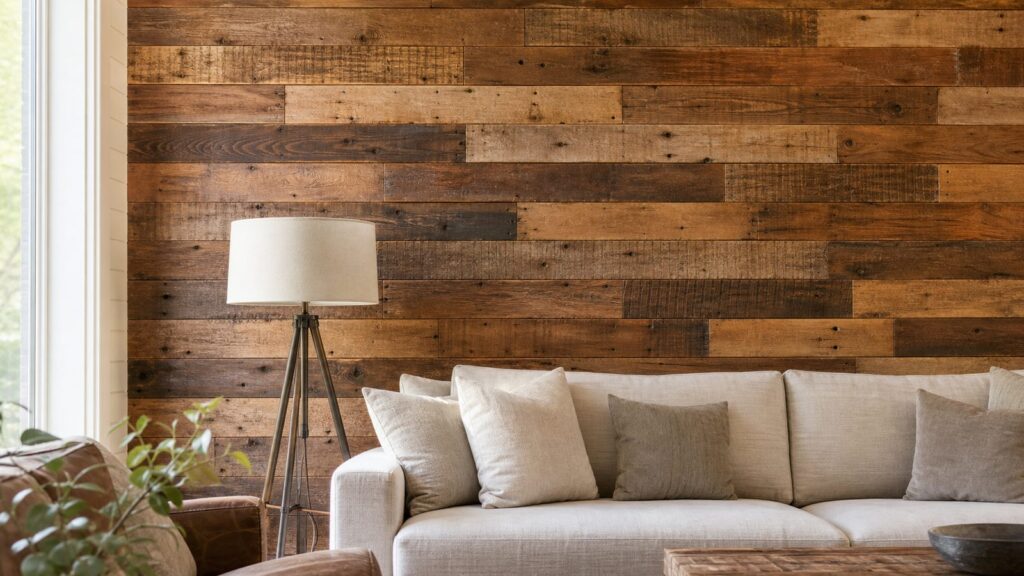
Reclaimed wood paneling is wall covering made from boards salvaged out of old structures, then cleaned and milled so it can go straight onto a modern wall. The good stuff comes from barns that stood for a century or more, which is why no new product can copy the look. At East Coast Rustic, every plank we sell was pulled from barns over 100 years old, and each board carries its own nail holes and saw marks, and no two planks weathered the same way.
This guide covers what separates real reclaimed paneling from imitations, what it costs, and how to pick the right boards for your wall.
What makes paneling “reclaimed”
True reclaimed paneling has a working past. Barn boards spent decades as siding or stall walls, drying and weathering through a hundred summers. That history shows up in the surface. You see saw kerf marks from old mills and nail holes from the original construction, with color that shifts board to board because each plank aged on its own.
Plenty of products borrow the name. New pine run through a distressing machine is “barn style,” not barn wood. Printed vinyl planks and thin stick-on veneers copy the color but feel flat the moment you touch them. If a listing never names the source of the wood, it usually was never inside a barn.
Brown or grey: picking a color line
We sell two lines of reclaimed wood paneling, both cut in 3.5 inch and 5.5 inch widths.
Brown natural mixes walnut, honey, caramel, and tan tones in the same panel. It suits warmer rooms: kitchens, dens, home bars, and anywhere with wood furniture or leather.
Grey comes from boards that weathered to a silver patina outdoors. It reads calmer and more modern, and it pairs well with white walls and black fixtures. Our grey design guide shows full rooms in that line.
Pick one line per wall. A single install mixes tones within its color family on its own, and that natural variation is what makes the wall interesting.
What reclaimed wood paneling costs
Authentic reclaimed paneling generally runs $8 to $15 per square foot in the US market. Thin peel-and-stick veneer costs less, and it looks like it. Solid boards cost more than veneer because you are buying real lumber with a century of character, and the price difference shows on the wall.
Our paneling is priced per square foot and ships in 20 square foot boxes, with free US shipping on orders over $200. A typical 8 by 10 foot accent wall is 80 square feet, so most feature walls land between $800 and $1,200 in materials depending on the color line. For a full walkthrough of budgeting a wall, see our accent wall cost breakdown.
Installing it is a weekend job
Reclaimed paneling goes up with a brad nailer and a saw. Boards come in random lengths up to 48 inches, and you stagger the seams row by row in a brick pattern so no two joints line up. Working around outlets and switches takes a jig or a careful measurement, and our planks are light enough that one person can handle the whole wall.
Christina Wilson’s Gordon Ramsay home makeover used our boards, and the Baltimore Ravens put them in their broadcast studio. Both installs used the same nail-up product we ship to homeowners. Our step-by-step installation guide covers the full process with photos.
Reclaimed vs the other paneling options
Shiplap: new, uniform, painted. Great for a farmhouse look, but it has no history and every board matches.
Engineered panels: a thin real-wood face glued to a substrate. Lighter and cheaper, but edges and depth give it away. We compared them head to head in reclaimed vs engineered wood panels.
Peel-and-stick veneer: the budget option. Millimeters thick, stuck on with adhesive, and known for lifting corners in humid rooms. Solid reclaimed boards nail to the wall and stay there.
Frequently asked questions
Is reclaimed wood paneling hard to install?
No. Most customers finish an accent wall in a weekend with a brad nailer and a miter or circular saw. The random lengths make the stagger pattern forgiving, since small measurement errors disappear into the layout.
Where does the wood actually come from?
Our boards are salvaged from barns that stood for 100 years or more before they came down. Every board is cleaned, de-nailed, inspected, and packed before it ships.
Can I use it in a kitchen or bathroom?
Kitchens, yes. It works as an accent wall or a sealed backsplash away from direct water. For bathrooms, keep it away from shower spray and use a ventilation fan. A clear matte sealer adds protection in humid rooms.
How much paneling should I order?
Measure wall width times height to get square feet, then add 10 percent for cuts. An 8 by 10 wall needs 88 square feet, which rounds up to five 20 square foot boxes.
Related reading
- DIY reclaimed wood walls: all products and live pricing
- How to install a reclaimed wood accent wall
- What a reclaimed wood accent wall costs
- Designing with grey reclaimed wood
Ready to see the wood in person?
Browse the 3.5 inch brown natural paneling or the full shop. Every box ships from real barns, priced per square foot, free US shipping over $200.