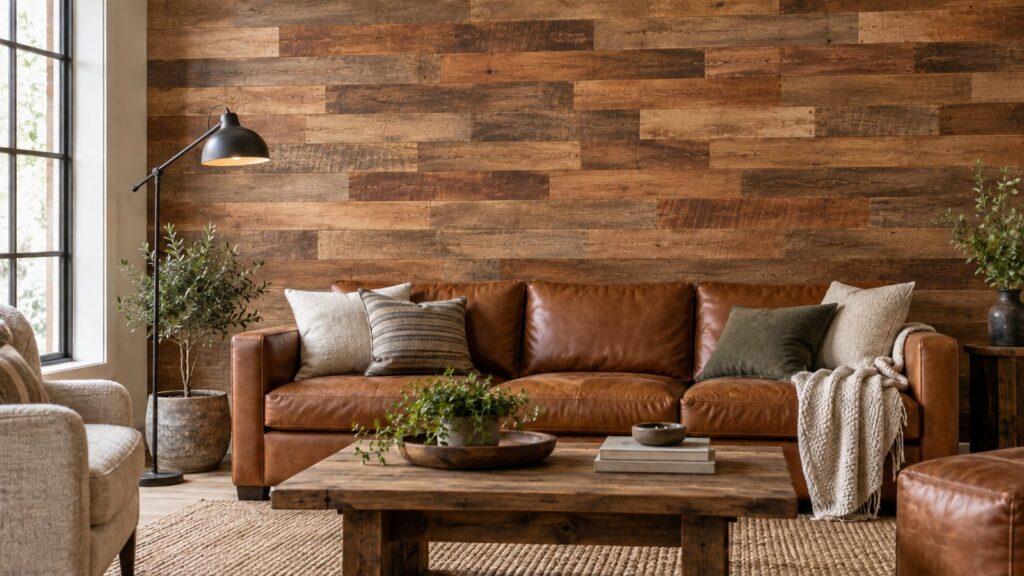
A barnwood feature wall is one wall, usually the first one you see when you walk into the room, covered in reclaimed barn wood planks. Planning one comes down to four decisions: which wall gets the wood, real barnwood or a lookalike, brown or grey, and how many square feet to order. Get those four right and the install itself is an afternoon with a caulk gun and a brad nailer.
Here’s how to work through each decision without ordering twice.
Pick the wall the room already points at
The best feature wall is the one your furniture faces. Behind the bed, behind the TV, the fireplace wall, the wall at the end of a dining table. In a home office, it’s the wall behind your desk, because that’s what shows up on every video call.
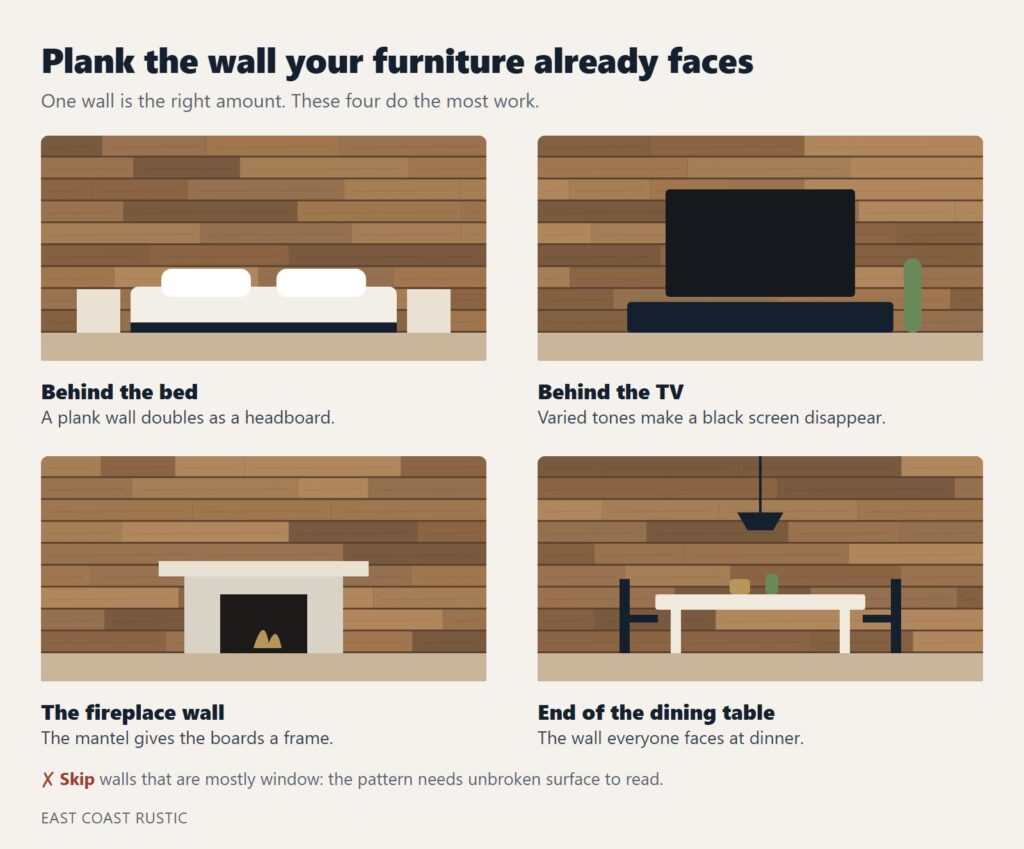
Skip walls that are mostly window. A feature wall needs enough unbroken surface for the plank pattern to read, and a wall that’s 60% glass never gets there. Outlets and switches aren’t a problem; you cut around them with a jigsaw and the cover plates hide the cuts.
One wall is the right amount.
Wrapping a whole room in barnwood tips it from “great wall” into theme restaurant, and it doubles your budget for less impact. The contrast against three painted walls is what makes the wood pop.
Real barnwood beats the lookalikes
Search “barnwood wall” and you’ll find three categories: thin peel-and-stick veneer, engineered panels with printed texture, and actual reclaimed barn wood. Here’s the trap with the first two: they look fine in a listing photo, but edges and corners give them away in person. A 1/8″ veneer has no depth, so the moment light rakes across it, the wall reads flat.
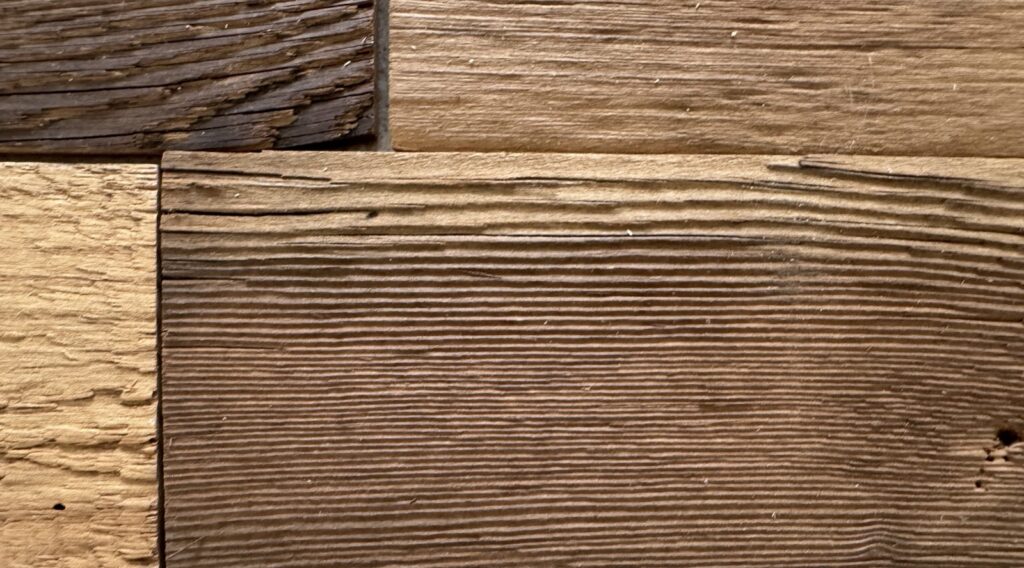
Real barnwood is different because the texture is earned. Our planks come off barns that stood for 100+ years, so the saw kerf marks, nail holes, and weathering go all the way through the board instead of sitting on a printed surface. At roughly 3/8″ thick, the planks throw real shadow lines, which is most of what makes a feature wall look expensive.
That’s why this material shows up in places that get photographed for a living: Gordon Ramsay’s restaurant builds, the Baltimore Ravens facility, ESPN sets, and Starbucks locations have all installed reclaimed barn wood. We’ve shipped over 1,100 orders of reclaimed barnwood planks for feature walls to homeowners doing the same thing on one wall instead of a whole set.
How much wood you’ll need
Measure the wall’s width and height in feet and multiply. Subtract large openings like a door, but don’t bother subtracting outlets or small windows; you’ll want that margin for cuts. Then add 10% for waste and trimming.
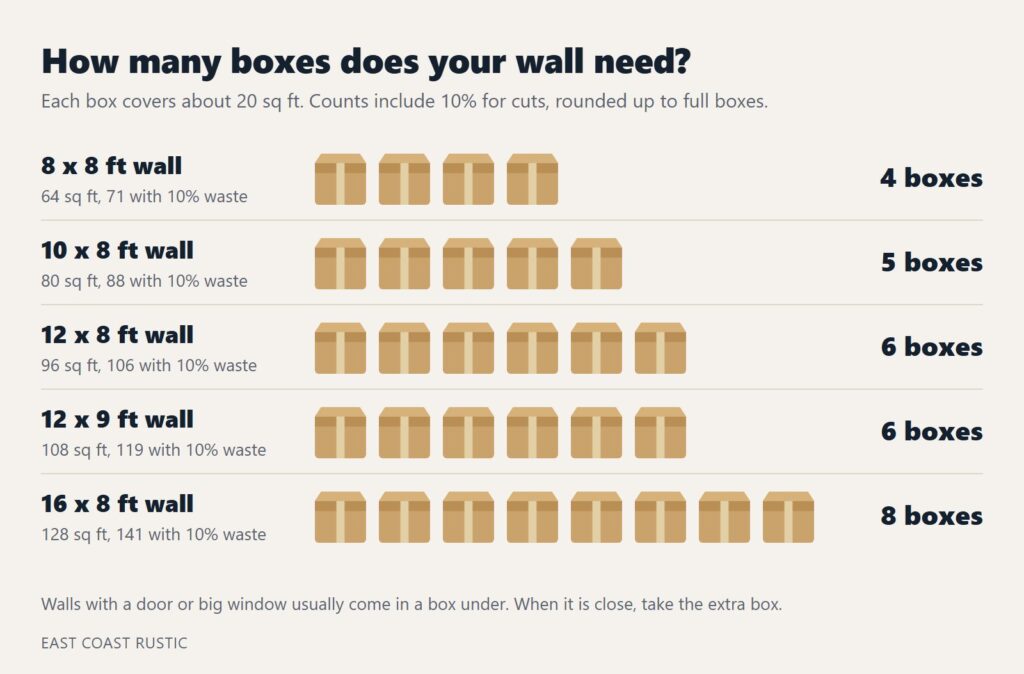
Our wood ships in 20 sq ft boxes at $10.75 per square foot, so a box runs $215. A typical 10 ft x 8 ft bedroom wall is 80 sq ft, which becomes 88 sq ft with waste, so you’d order five boxes (100 sq ft) and have a bit left over for shelves or a frame project. That puts most feature walls in the $1,000 to $1,300 range, and shipping is free in the US on orders over $200, which every box order clears.
Planks come in 3.5″ or 5.5″ widths, in random lengths up to 48″. The narrower boards read busier and more rustic; the 5.5″ boards read calmer and suit bigger walls. Full pricing detail is in our accent wall cost guide.
Brown or grey?
Both lines are real reclaimed barnwood; the difference is how the boards weathered. Brown planks carry warm walnut, honey, and tan tones and suit traditional, farmhouse, and cabin rooms. Grey barnwood planks weathered to charcoal and silver, and they’re the better call in modern, coastal, and Scandinavian-leaning rooms.
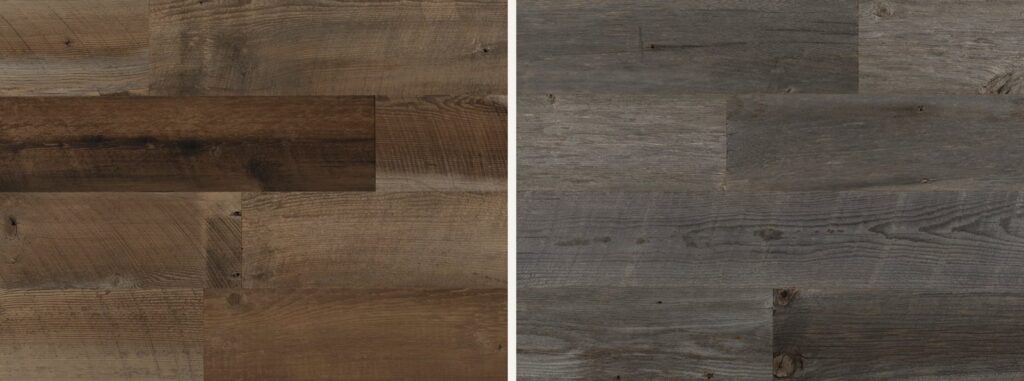
Pick one line per wall. Mixed brown-and-grey installs sound interesting and look like a mistake, which is why we don’t sell them that way. If you’re torn, match the wood to your floor: warm-toned floors take brown, cool-toned floors take grey.
What install day actually looks like
This is a one-afternoon project for one person. Snap a level line, spread construction adhesive on the back of each plank, press it to the drywall, and shoot a couple of brad nails to hold it while the glue cures. The adhesive does the real work, so you don’t need to find studs; brads can go anywhere.
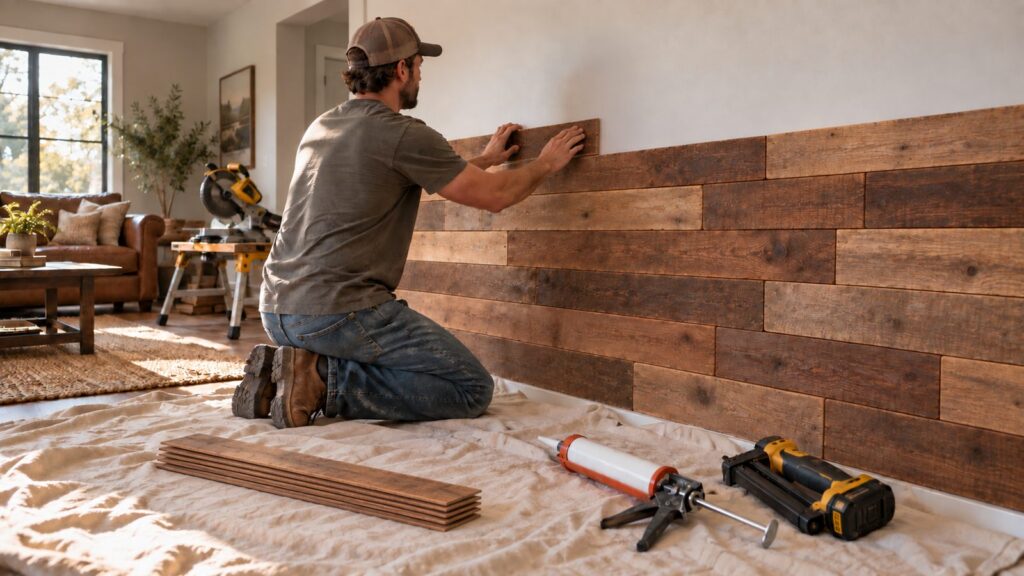
Stagger the end seams like brickwork so no two rows line up. Because the planks arrive in random lengths capped at 48″, the stagger mostly happens on its own; just don’t start two consecutive rows with same-length boards. A miter saw handles the end cuts, and the full tool list is in our step-by-step install guide.
Frequently asked questions
How much does a barnwood feature wall cost?
At $10.75 per square foot, a typical 80 sq ft wall costs about $1,075 in wood once you add 10% for cuts. Adhesive, brads, and stain-free finishing add maybe $50. US shipping is free over $200.
Can I install a barnwood feature wall myself?
Yes. It’s construction adhesive plus brad nails into drywall, no studs required, and most customers finish one wall in an afternoon with a miter saw, a caulk gun, and a brad nailer.
Which rooms work best for a barnwood wall?
Bedrooms, living rooms, dining rooms, offices, and basements all work well. Avoid direct-moisture spots like shower surrounds; a powder room or kitchen wall away from the sink spray zone is fine.
Do I have to stagger the planks?
Yes, stagger the seams in a brick pattern. Aligned seams create visible vertical lines that break the look. Random plank lengths up to 48″ make the stagger nearly automatic.
Related reading
- Reclaimed wood accent wall ideas for every room
- How to install a reclaimed wood accent wall
- How much does a reclaimed wood accent wall cost?
- DIY accent walls
Ready to plan your feature wall?
Measure your wall, add 10%, and order by the square foot. Our brown 3.5″ reclaimed barnwood planks are the most popular starting point, and the grey line ships the same way: real 100+ year old barn wood, cut to install in an afternoon.