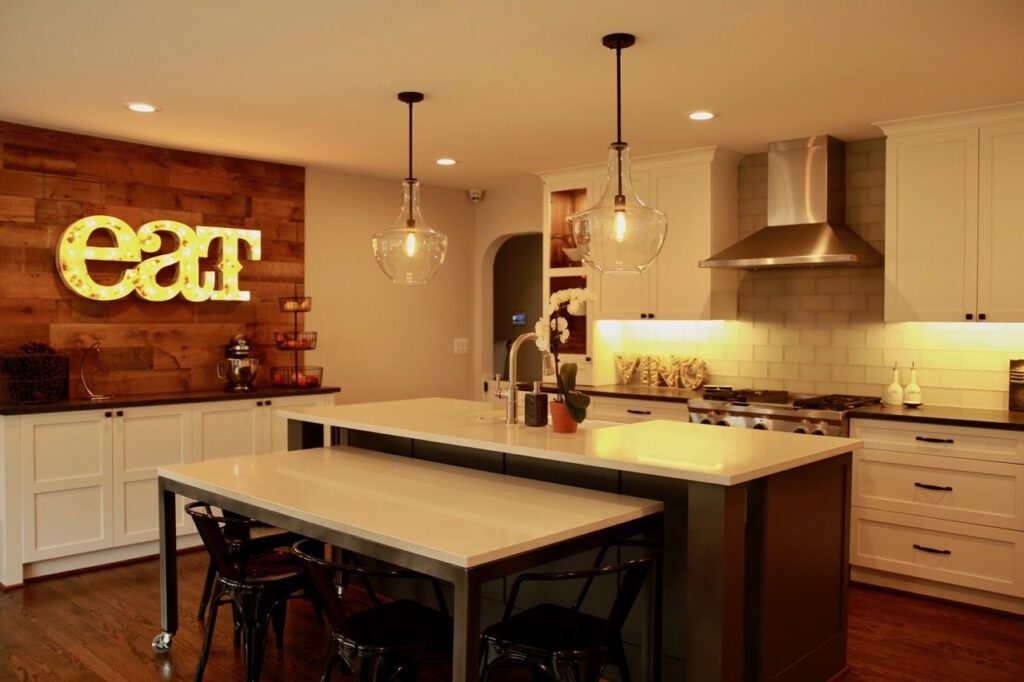
Glue does the holding. On a wood plank wall, construction adhesive bonds each plank to the drywall permanently, and nails play a supporting role at best: a brad or two keeps the board tight while the adhesive cures. You don’t need a stud finder, you don’t need to hit studs, and you don’t need to fill nail holes afterward. Here’s how the two methods compare on real 3/8 inch reclaimed planks, and the glue-first approach we recommend after shipping wood for over 1,100 accent walls.
Construction adhesive does the holding
One tube of construction adhesive such as Liquid Nails Heavy Duty covers about 40 square feet of plank wall, and that bead is what carries the wall for the life of the room. Applied edge to edge in a wavy S pattern, it grips the full back of every board, so the weight spreads across the whole wall instead of hanging on a few fasteners.
Two details make the bond stronger. Cut the tube tip to a 1/4 inch opening so the bead has some body, and vacuum the back of each plank before gluing. Our boards come out of barns that stood for more than 100 years, and a dusty back is the main reason an adhesive bond ever lets go. Press each board on with a slight twisting motion to spread the bead.
One warning: wood glue is the wrong product for this job. It’s made to bond wood to wood, it grabs slowly, and it can’t bridge the small gaps behind a rough sawn board. Construction adhesive handles all of it.
Nails are a clamp, not a fastener
A brad or two per plank, shot anywhere along the board, simply holds it tight to the wall while the adhesive sets over the first 24 hours. The brads never carry any real weight, so there’s no reason to hunt for studs; an 18 gauge brad into bare drywall does the clamping job fine.
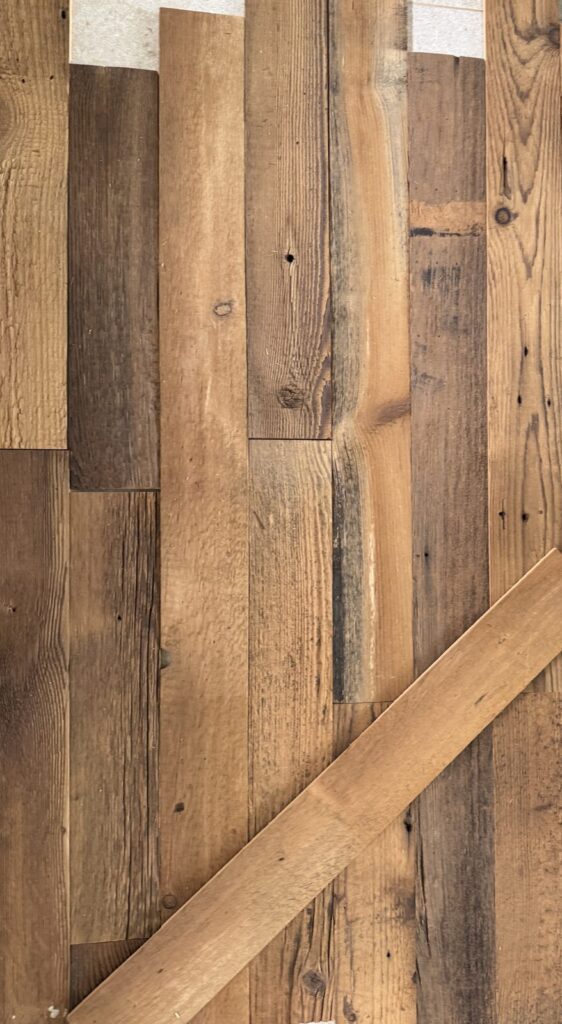
Don’t own a brad nailer? You don’t need one. Our recommended method swaps nails for 4 to 6 dots of hot glue at the corners and center of each board. The hot glue grabs instantly while the construction adhesive cures to full strength underneath. Our step by step installation guide walks through the whole dual adhesive method.
Brads do have one cosmetic advantage on reclaimed wood: the heads disappear into the weathered grain, no filler, no touch up. On smooth new lumber, every hole shows.
Why the find-the-studs advice doesn’t apply here
Stud nailing exists for thick, heavy boards. Our reclaimed planks are 3.5 or 5.5 inches wide, come in random lengths up to 48 inches, and measure about 3/8 inch thick, closer to wall paneling than to lumber, so adhesive spread across the back holds them with room to spare.
Most install guides online were written for 3/4 inch shiplap and tell you to drive three nails through every stud. Follow that advice with random length planks and you hit a math problem fast: studs sit 16 inches apart, and half your board ends will never land on one.
Here’s the trap with skipping the glue entirely: drywall alone has very little grip on a brad. A nail-only wall feels solid the day you finish it, then indoor humidity swings work the boards loose season after season.
The glue is not optional.
Tools, cost, and one afternoon
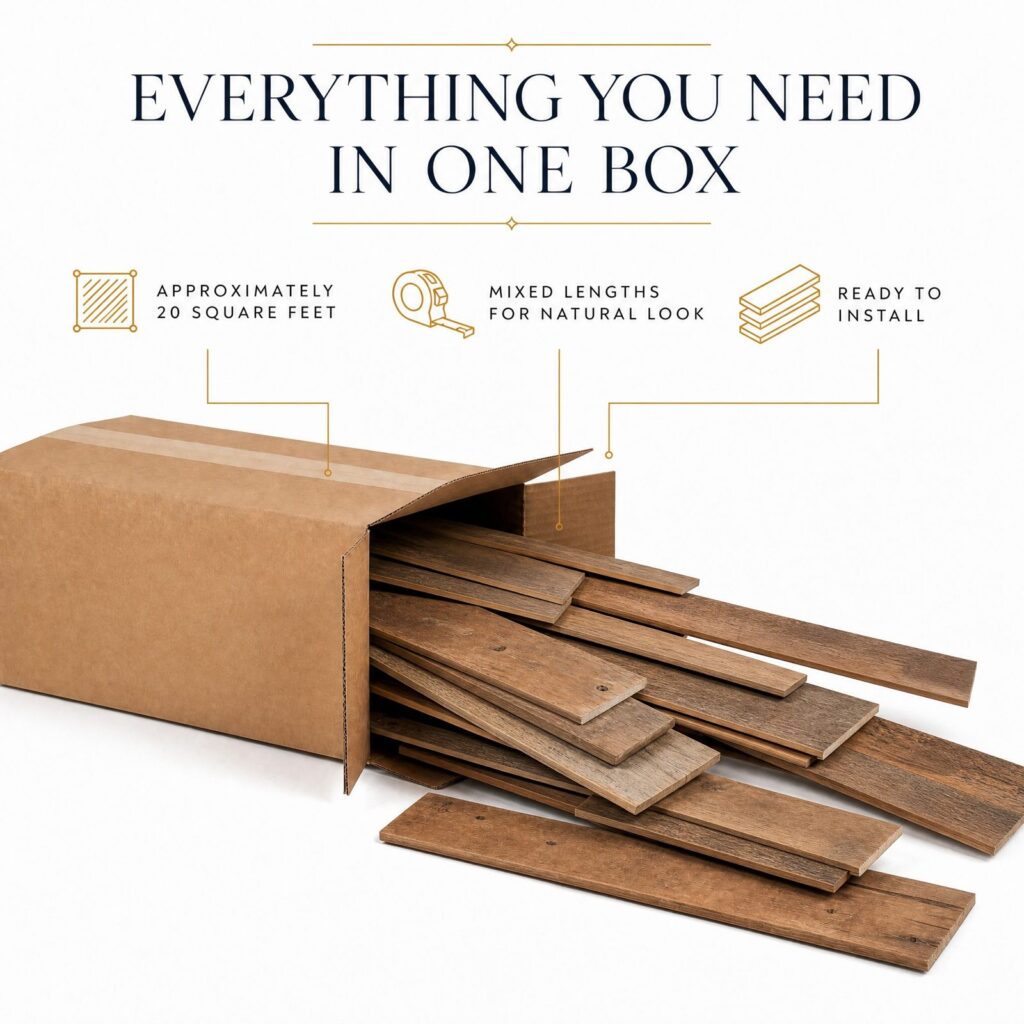
For an 8 by 10 foot wall, plan on about $1,025 in planks at the current sale price of $10.25 per square foot for brown reclaimed wood planks: 80 square feet plus 10% for cuts rounds up to five 20 square foot boxes. Add $20 to $40 for adhesive and supplies. Grey reclaimed planks install exactly the same way at $13.50 per square foot.
The tool list is short: a caulking gun, tape measure, level, pencil, and something to cut with. A $15 miter box from the hardware store works, and a jigsaw helps around outlets. The brad nailer is optional. Shipping is free on US orders over $200 (Alaska and Hawaii pay shipping), which every box order clears.
This is the same glue-first method behind the walls we’ve shipped to over 1,100 customers, including the Hell’s Kitchen winner home makeover Gordon Ramsay ran and the Baltimore Ravens’ broadcast studio. Two people can finish a wall in an afternoon.
Frequently asked questions
Do I need to find studs to install a wood plank wall?
No. Construction adhesive does the holding, and the brads that keep each board snug while it cures can go anywhere, straight into drywall. A stud finder stays in the drawer for this project.
Can I install wood planks with nails only?
Not on 3/8 inch planks. Brads into drywall have almost no long term grip, and random length boards rarely end on a stud. Nail-only walls loosen as indoor humidity changes, so always glue.
How long does the adhesive take to cure?
The hot glue dots or brads hold everything in place immediately. Construction adhesive sets within 24 hours and reaches full strength in about a week. The wall is done the day you finish it; just don’t pry on the boards that first week.
Will removing the planks later damage my drywall?
Yes. Construction adhesive bonds to the drywall paper, so taking a wall down usually means patching or re-skimming the drywall behind it. Treat a glued plank wall as a long term decision, which is exactly why it never falls off.
Related reading
- How to install a reclaimed wood accent wall
- How to stagger wood planks on a wall
- How much wood do I need for an accent wall?
- How to cut around an electrical outlet in a wood wall
- DIY accent walls: the complete guide
Ready to see the wood in person?
Every order ships as real 3/8 inch planks cut from barns that stood for a century, ready to glue straight to your drywall. Browse the brown 3.5 inch reclaimed wood planks, pick your square footage, and your boxes ship free anywhere in the US outside Alaska and Hawaii.