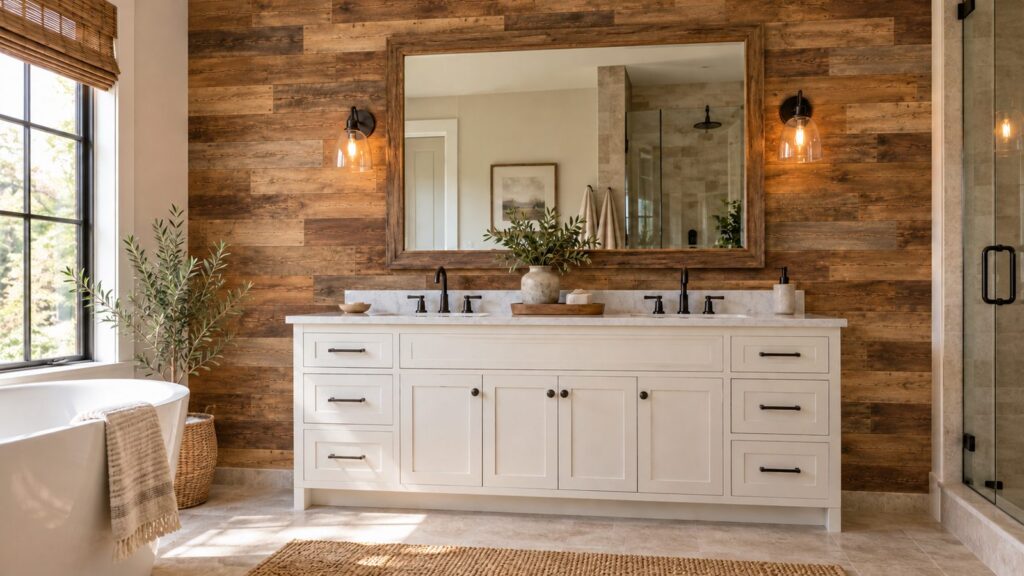
Yes, you can put a reclaimed wood bathroom wall anywhere that stays out of direct water. Real barn wood looks right at home behind a vanity, on a powder-room feature wall, or on a half wall, as long as the boards aren’t getting sprayed or soaked. Keep it off the shower surround and away from the tub spout, give the room a working exhaust fan, and reclaimed wood holds up in a bathroom for years.
Here’s the honest version of how to do it well.
Can you put reclaimed wood on a bathroom wall?
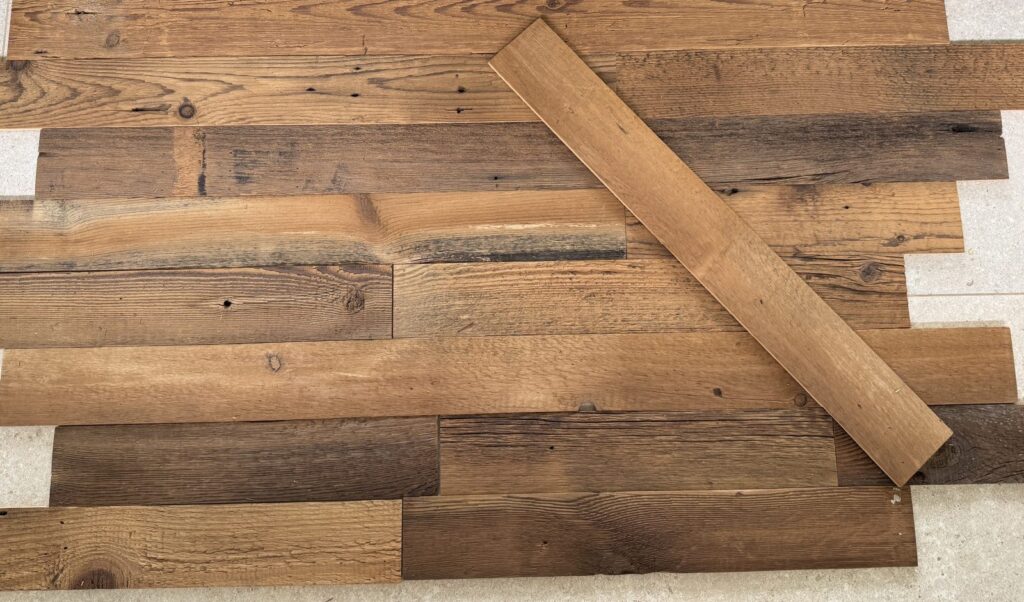
You can, and it’s one of the warmest looks in a bathroom, but placement is everything. Reclaimed wood belongs on walls that only ever see humidity and the occasional splash, not standing water. Our planks are real 3/8-inch boards milled from barns that are 100-plus years old, so they’ve already lived through a century of seasonal humidity swings. A bathroom’s day-to-day moisture isn’t the problem. Direct water is.
So the rule is simple. If a spot gets wet when you shower or run the tub, skip the wood there. Everywhere else is fair game.
The best places for reclaimed wood in a bathroom
The safest, best-looking spots are the vanity wall, a powder-room feature wall, the wall behind the toilet, and a half wall that stops below the splash zone. These are the areas that stay dry during normal use, so the wood just reads as a warm backdrop.
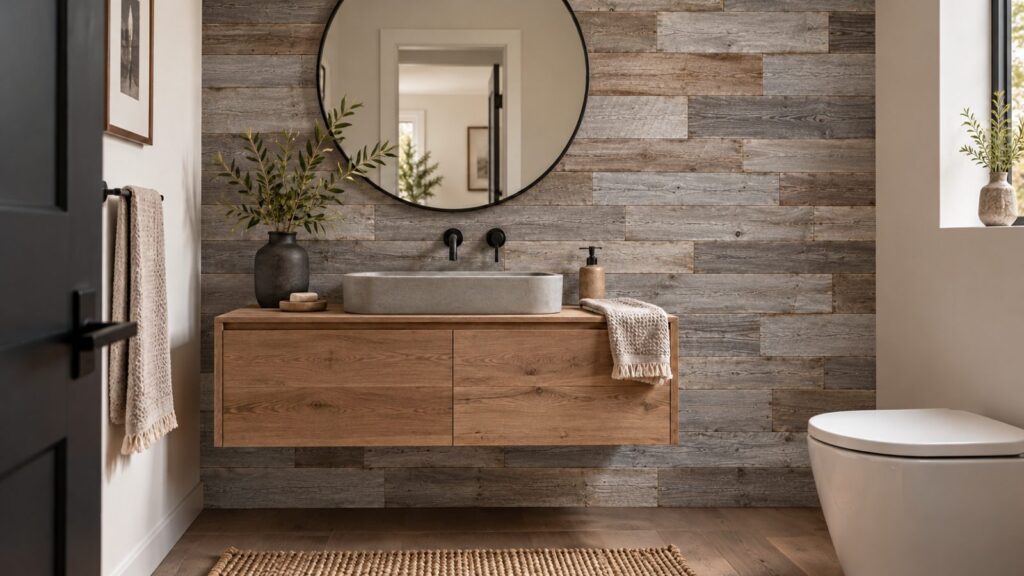
Powder rooms are the easy win. There’s no shower or tub, so the whole room is fair game, and a small space means a big design payoff for not much wood. Grey planks look especially sharp in a powder room with modern fixtures, while the brown line leans farmhouse. Both lines are in stock, so you can match the wood to the rest of your finishes.
Where you don’t want it: inside a shower or tub surround, on the wall the showerhead sprays, or directly behind a sink where water pools against the boards. Those zones need tile. Trying to force wood there is the one mistake that turns a great project into a warped mess.
If you want the full wall-by-wall logic, our guide to making a wood backsplash work in a real kitchen covers the same splash-zone thinking that applies over a bathroom sink.
How to protect reclaimed wood from bathroom moisture
Three things keep a bathroom wood wall healthy: a sealer, ventilation, and a little breathing room. Wipe on a matte or satin polyurethane (two thin coats) so humidity can’t soak into the grain, run the exhaust fan during and after every shower, and leave a small gap at the floor so the bottom edge never wicks water. Aim to keep the room between 35 and 55 percent humidity, same as you would for any solid wood indoors.
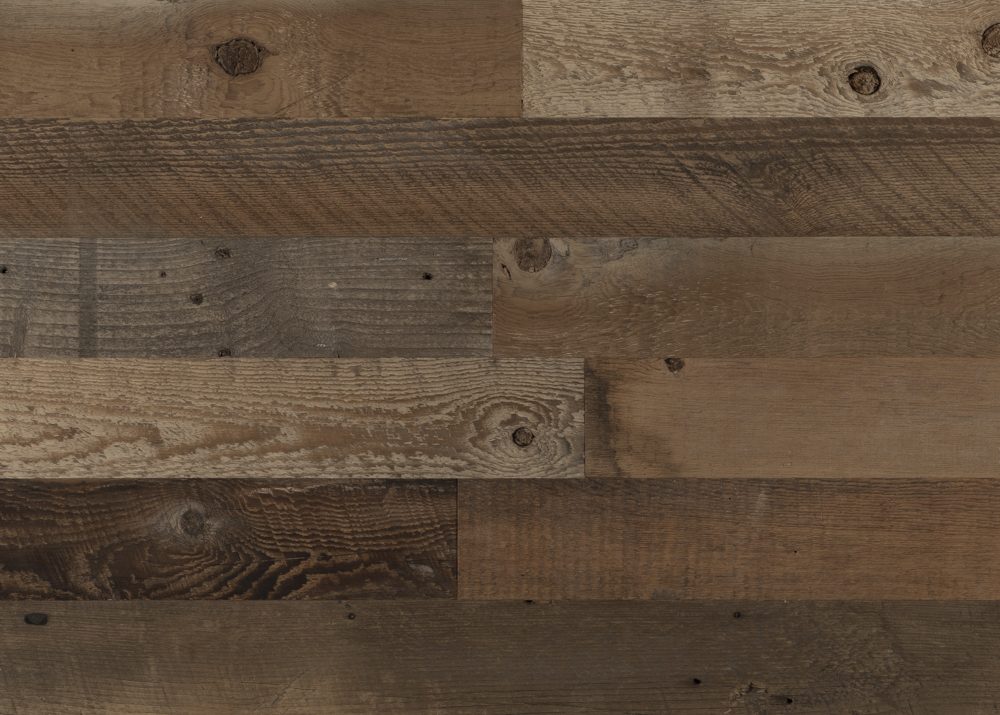
A matte sealer is the move, not a glossy one. Gloss fights the whole point of reclaimed wood by making century-old boards look plastic. Matte protects the surface and keeps the low-sheen, soft texture that makes the wall look real.
For the install itself, a quality construction adhesive does the holding and a brad or two anywhere on the board keeps it flat while the glue cures. You don’t need to find studs, and you shouldn’t glue wood straight onto bare or damp drywall in a wet room. If the bathroom runs humid, seal the wall surface first and let it dry. More on prep and what’s actually in the wood is in our post on whether reclaimed wood is safe for indoor use.
What a reclaimed wood bathroom wall costs
Most bathroom walls are small, so the total is friendly. Each box covers 20 square feet, and the brown 3.5-inch line runs $10.25 per square foot right now. A 5-foot by 8-foot vanity or powder-room feature wall is 40 square feet, which is two boxes, so about $410 in brown before shipping. US shipping is free over $200, so most bathroom projects ship free.
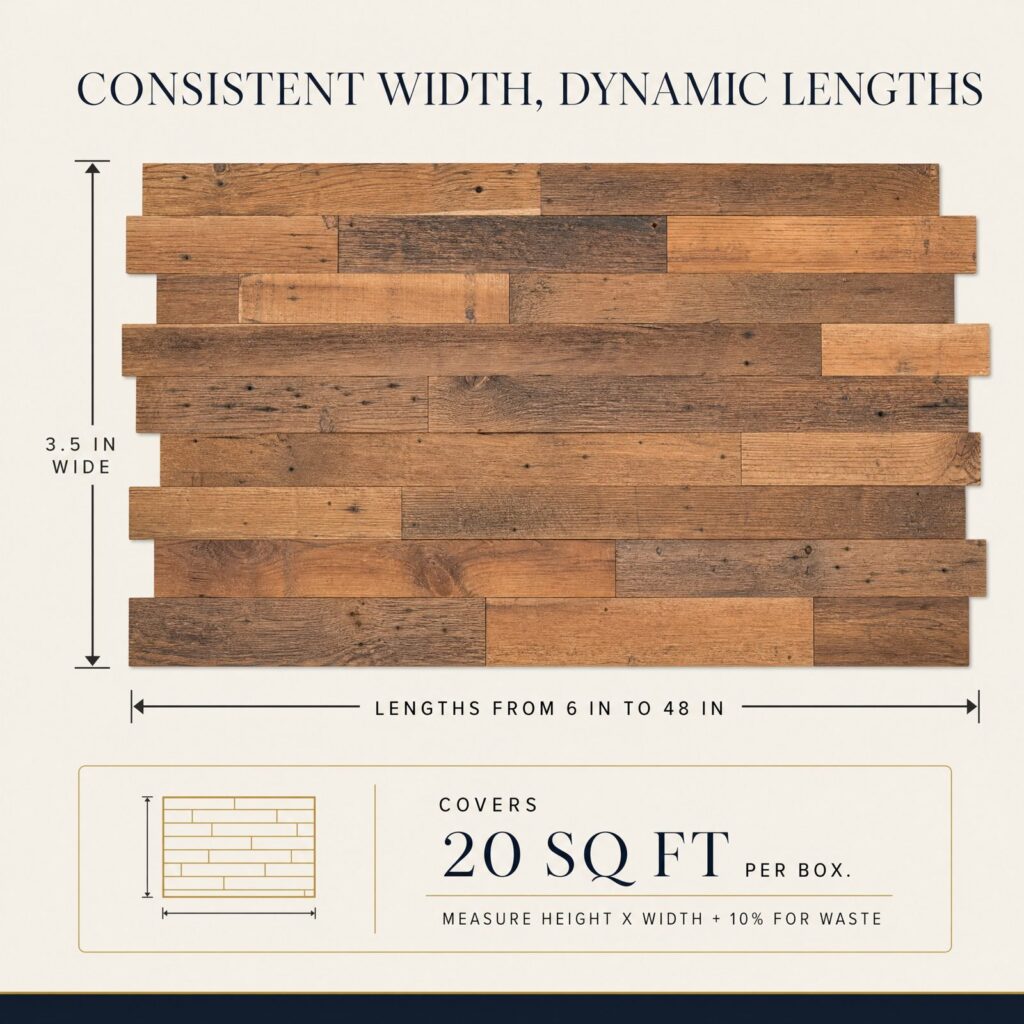
The grey line prices a little higher at $13.50 per square foot, so that same 40-square-foot wall lands near $540. Order 10 percent extra to cover cuts and pick your best boards, then round up to the next full box. A single accent wall behind the toilet can be as little as one box.
Frequently asked questions
Will reclaimed wood warp in a bathroom?
Not on a dry wall with a working fan. The boards are old, already dimensionally settled, and sealed before they ever see steam. Warping happens when wood sits in direct water or a room with no ventilation, which is why placement and an exhaust fan matter more than anything else.
Can I put reclaimed wood in a shower?
No. A shower surround sees constant standing water and needs a waterproof surface like tile. Reclaimed wood is for the dry walls around the wet zones, not the wet zone itself.
Do I need to seal the wood before installing it?
In a bathroom, yes. Two thin coats of matte or satin polyurethane before or right after install keep humidity out of the grain. In a dry room you can skip sealing, but a bathroom earns the extra step.
Does reclaimed wood hold up behind a toilet or sink?
Behind a toilet, yes, that wall stays dry. Behind a sink, keep the boards above and to the sides of the splash zone, or add a small tile or glass backsplash where water actually hits.
Related reading
- Wood backsplash: how to make it work in a real kitchen
- Is reclaimed wood safe for indoor use?
- How to install a reclaimed wood accent wall
- What a reclaimed wood accent wall costs
- See all DIY wall projects
Ready to see the wood in person?
Pick your color and we’ll ship it to your door, free over $200. The brown 3.5-inch planks are the farmhouse favorite, and the grey 3.5-inch planks suit a cleaner, modern bathroom. Both are real 3/8-inch reclaimed boards from century-old barns, the same wood trusted by Gordon Ramsay and the Baltimore Ravens.