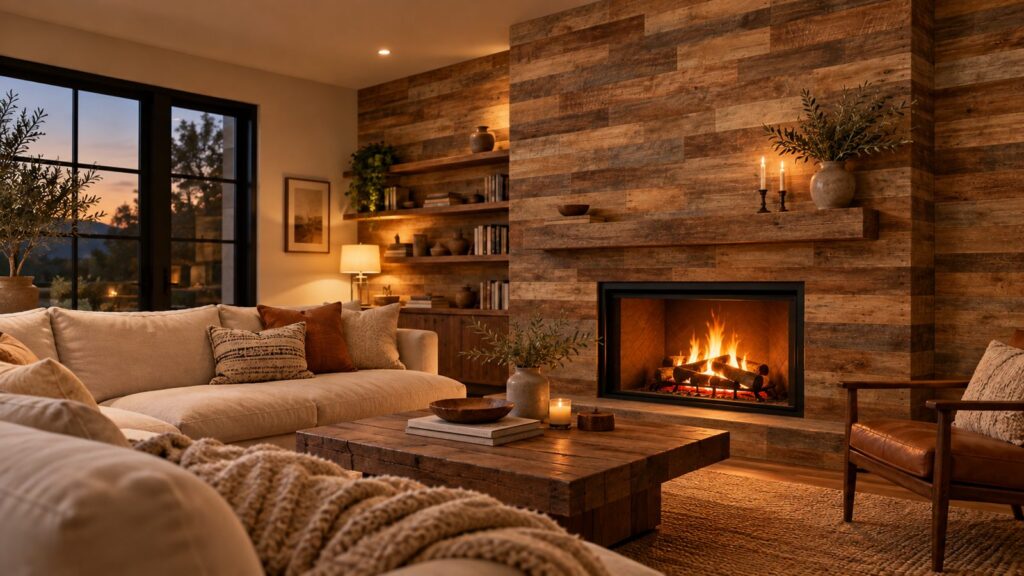
Yes, you can put reclaimed wood around a fireplace, and it’s one of the best spots for it. The planks cover the wall around the firebox, the chimney breast above it and the wall to either side, while you keep a non-combustible border between the wood and the opening. Real reclaimed wood is combustible, so clearance is the one step you can’t skip. Get that right and the rest is a normal accent-wall install.
Can you put reclaimed wood around a fireplace?
Yes. Reclaimed wood looks right at home framing a fireplace, and East Coast Rustic’s 3/8-inch planks go up with construction adhesive over drywall. The one rule that matters: real wood burns, so it stays outside the firebox’s clearance-to-combustibles zone, with a non-combustible border of stone, tile, brick or finished cement board between the planks and the opening.
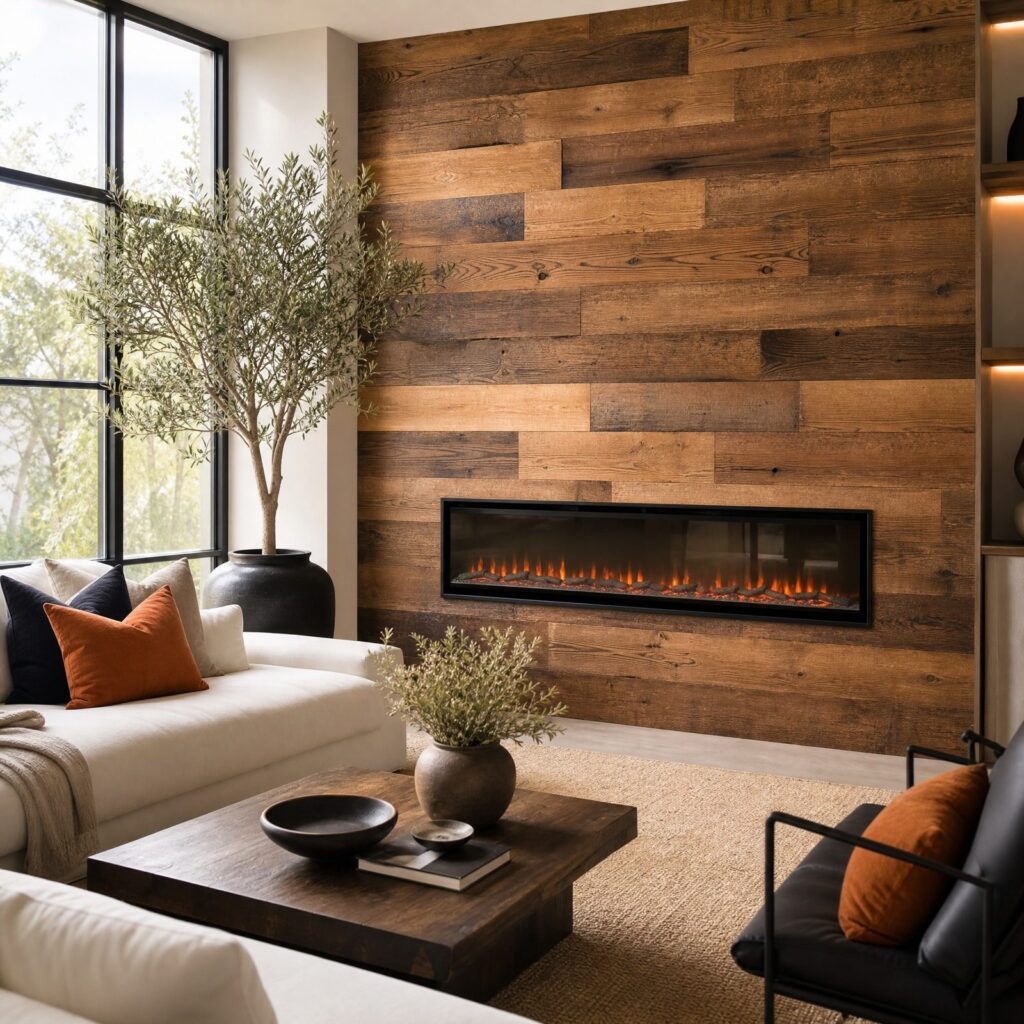
Your fireplace type decides how much room you need. Electric fireplaces throw almost no heat at the glass, so most let you run wall covering right up to the unit as long as you follow the manual. Gas and wood-burning fireboxes are a different story and carry listed clearances you have to respect. When Gordon Ramsay’s team wanted a warm, real-wood backdrop for a home makeover, this is the look they chose, and the planks sat on the wall around the hearth, not on the firebox itself.
Fireplace clearance and code basics
For a masonry wood-burning fireplace, the International Residential Code keeps combustible material at least 6 inches back from the firebox opening, and anything that projects more than 1.5 inches from the face has to sit at least 12 inches away. Flat wall planks sit nearly flush, so the 6-inch rule is the one that governs reclaimed wood.
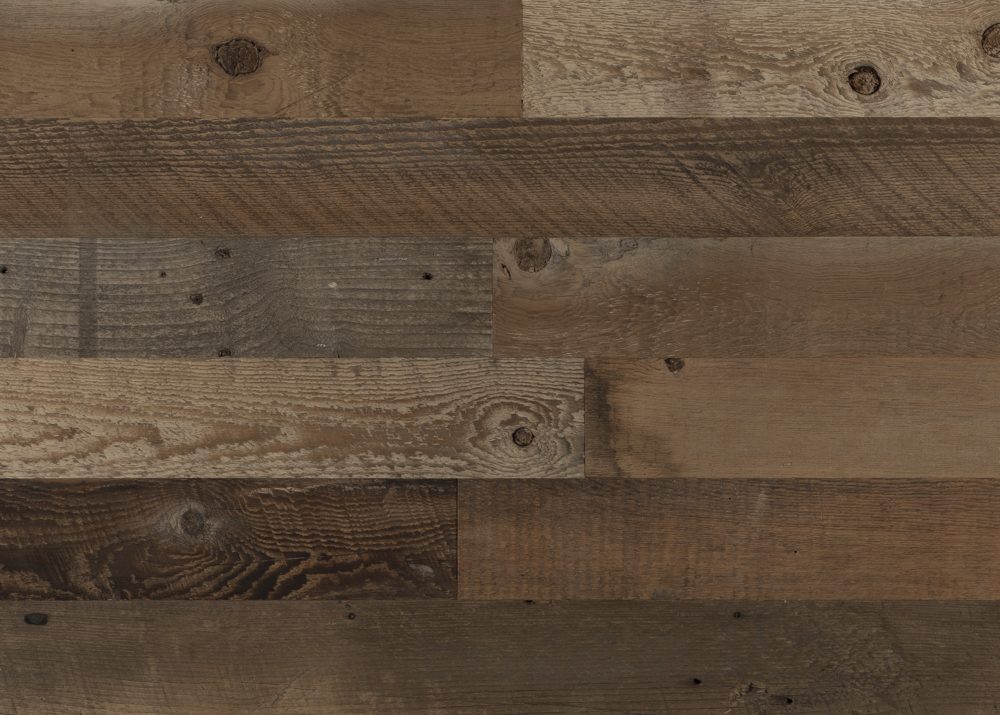
Gas and factory-built units are their own case. Follow the clearance printed in the unit’s manual, because a listed appliance can call for more room than code, and the manual wins. Electric units are usually the easy ones, with little or no clearance needed at the face.
Here’s the trap I see most: people glue planks straight onto the metal surround or the hot masonry right at the opening because it looks tidy. Don’t. Leave that border in stone, tile, brick or a finished non-combustible panel, start the wood past it, and if you’re on a wood-burning or gas unit, have your local inspector confirm the clearance for your setup before you glue anything.
Planning your fireplace wall layout
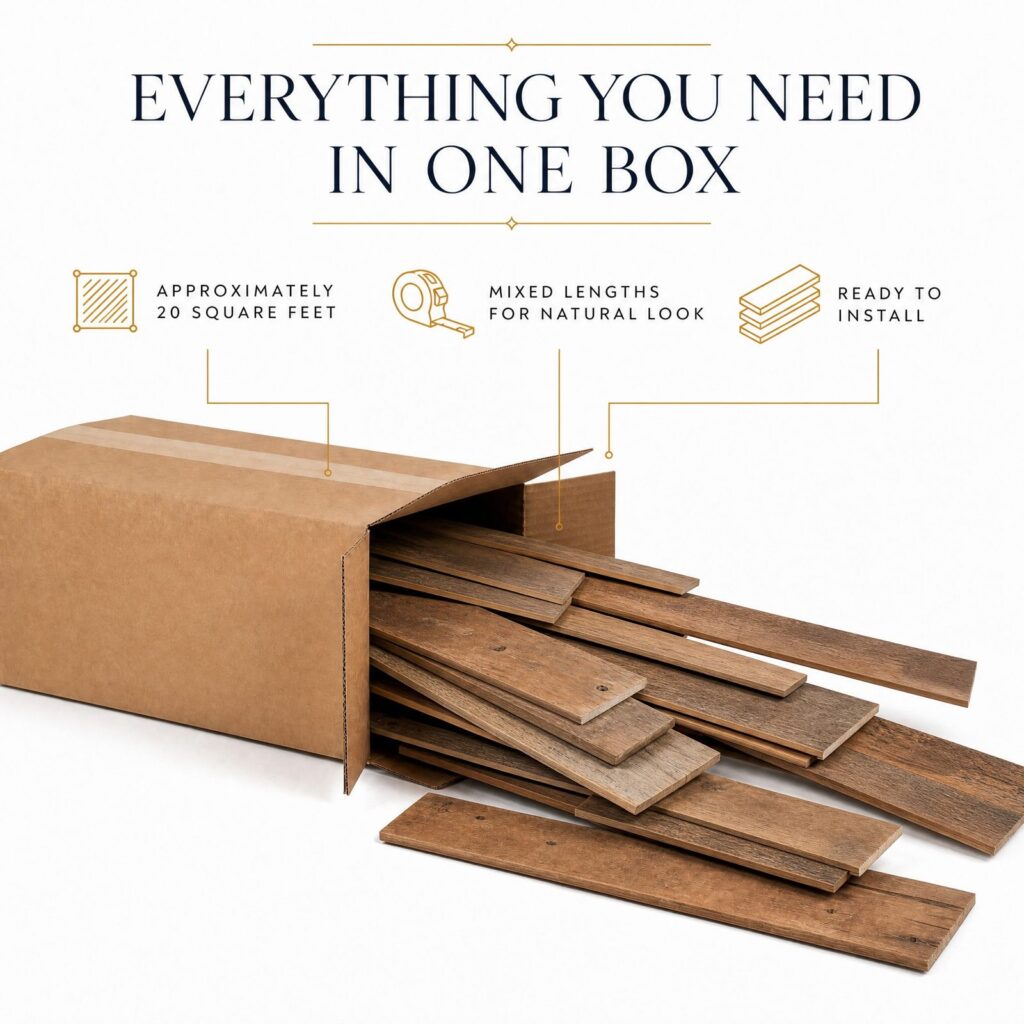
Measure the area you’re covering, subtract the firebox opening, add 10% for waste, then divide by 20 to get your box count, since each box covers about 20 square feet. A typical chimney breast around 6 feet wide by 8 feet tall works out near 48 square feet, so after the firebox cutout and waste you’re usually at 3 boxes.
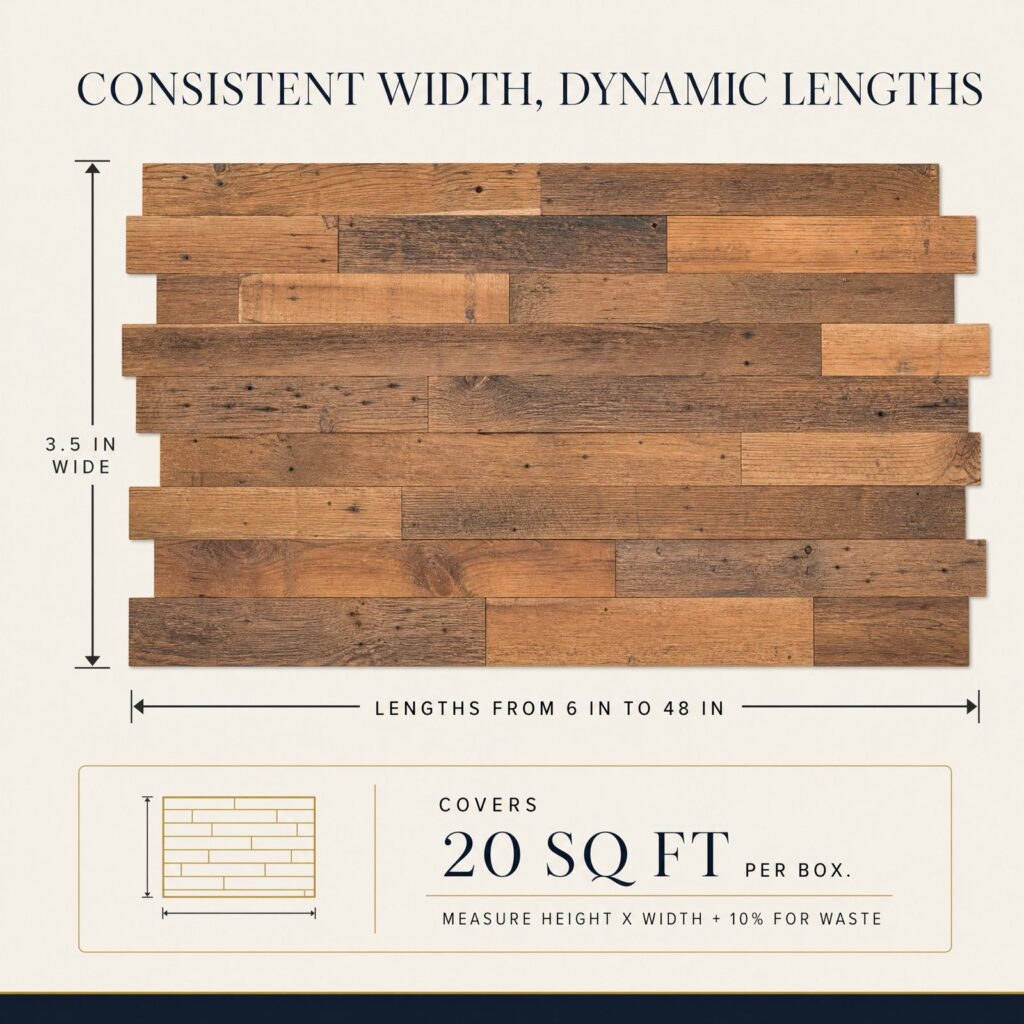
The planks come 3.5 and 5.5 inches wide in random lengths up to 48 inches, which is what gives a fireplace wall that staggered, brick-pattern run instead of a grid. At corners you butt the boards together and alternate which side laps over, row to row, so the seam stays random. Where the wood stops, snap a level or plumb line, sand the end boards, and finish right on that line. No cap or edge piece needed.
Three boxes of the brown 3.5-inch planks runs about $615 at the current $10.25 per square foot, and the grey 3.5-inch line at $13.50 lands near $810 for the same wall. US shipping is free over $200, so a fireplace-sized order ships at no extra cost. If you want the math worked out for your exact wall, the coverage guide has the full formula and a box chart.
Installing the planks around a fireplace
Construction adhesive does the holding, and a brad or two anywhere on each board just pins it while the glue sets, so you don’t need to find studs. Keep both the adhesive and the wood out of the firebox clearance zone, and never glue planks onto a hot masonry surround.
On a standard drywall chimney breast you install exactly like any accent wall: run a bead of adhesive, press the board, add a brad, move on. Over a brick or stone chimney breast, fasten a thin plywood substrate first, well outside the heat zone, and plank over that so you’ve got a clean surface to glue to.
These boards are thin, about 3/8 inch, roughly the thickness of a pencil, so they tuck in close to switch plates and the fireplace border without looking bulky. For the full bead pattern and tool list, the stagger and install guide walks through it. Honestly, the glue-and-brad method is forgiving, and the random lengths hide small layout mistakes on their own.
Frequently asked questions
Is reclaimed wood a fire hazard around a fireplace?
Reclaimed wood is combustible like any solid wood, so it isn’t a hazard when it’s kept outside the firebox’s clearance zone with a non-combustible border at the opening. The wood lives on the wall around the fireplace, not on the firebox itself.
How far should the wood be from the firebox?
For a masonry wood-burning fireplace, keep combustible material at least 6 inches from the opening per the IRC. For gas and factory-built units, follow the clearance in the manufacturer’s manual, which can be larger, and confirm with your local inspector.
Can I put reclaimed wood over a brick fireplace?
Yes. Fasten a thin plywood substrate to the brick outside the heat zone, then glue and brad the planks to that. Keep the wood back from the firebox opening by the required clearance.
Do I need a mantel or edge piece to finish it?
No. The planks stop on a snapped level or plumb line with the end boards sanded smooth, and corners are butt joints with the overlap alternating row to row. The random lengths keep the edge looking intentional on their own.
Related reading
- Reclaimed wood fireplace wall (product overview)
- How much wood do I need for an accent wall?
- How to stagger wood planks on a wall
- Is reclaimed wood safe for indoor use?
- Shop all DIY reclaimed wood walls
Ready to build around your fireplace?
See the real wood before you plan your layout. Our planks are 3/8-inch thick boards milled from 100-year-old barns, in warm brown and weathered grey, priced per square foot with free US shipping over $200. Start with the brown 3.5-inch accent wall planks and bring the character of real reclaimed wood to your fireplace.