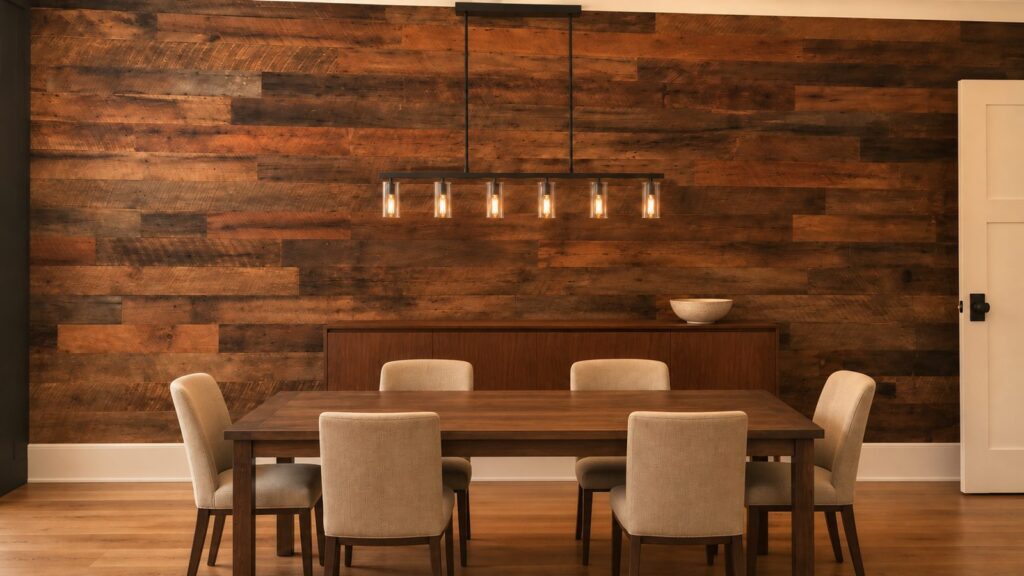
A reclaimed wood dining room wall goes on the wall the table faces, costs about $1,230 in brown or $1,620 in grey for a typical 12 by 8 foot wall, and takes one weekend to install with construction adhesive and a brad nailer. The dining room is the easiest room in the house to get this right. The furniture never moves and the wall behind it is usually blank. You also use the room at the time of day when the light is warm and low, which is when the wood looks best.
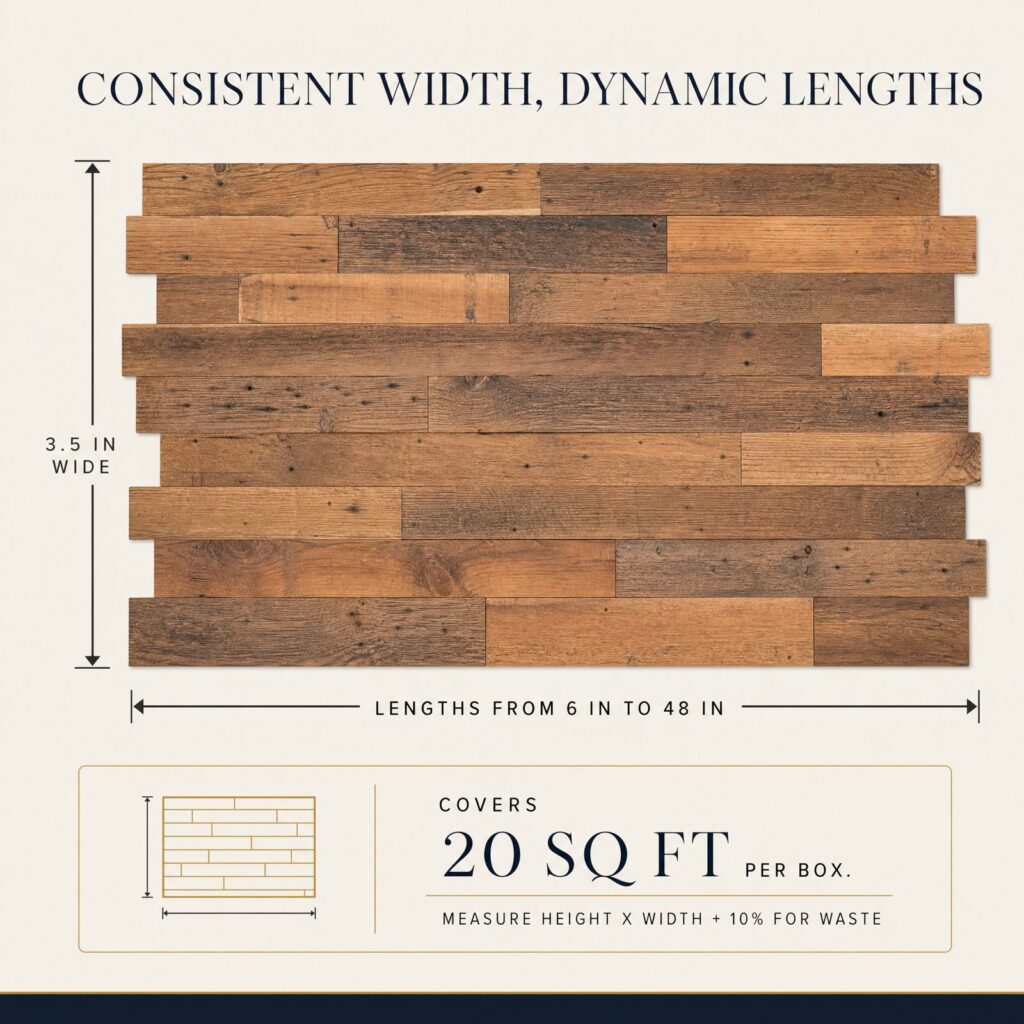
The boards are the same ones on every wall we ship, 3/8 inch thick reclaimed wood planks from barns over 100 years old, in 3.5 or 5.5 inch widths and random lengths up to 48 inches.
Which dining room wall gets the wood
Put the planks on the wall you see from the doorway or from the kitchen, which in most houses is the long wall behind the head of the table. One wall only. A dining room with wood on two walls starts to feel like a cabin, and the second wall adds nothing the first didn’t already say.
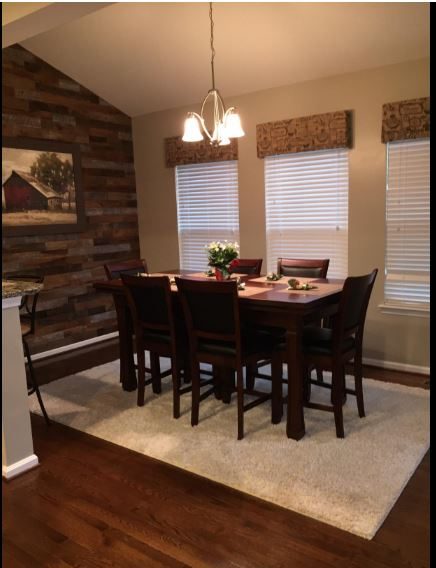
The long wall behind the table is the default in the photos customers send us, and it works in any room where the table sits parallel to it. The short end wall is the better pick when the room opens to a living area and you want the wood to read as a backdrop from the sofa. In an open plan where the table floats and no wall is really “behind” it, plank the wall behind the sideboard or buffet instead. We’ve also seen it on the half wall of a breakfast bar between the kitchen and the table, which uses two boxes and still changes the whole room.
Skip the wall with the window. Daylight coming from behind the planks flattens the color, and you’ll lose a third of the wall to the window anyway. Put the wood opposite the window instead, where the light lands on it.
If the room has a chair rail, decide now whether it stays. Most people take it off and plank the full height, which is cleaner and costs about the same once you count the half wall above it. The planks go straight over the paint; the chair rail comes off with a pry bar and ten minutes of patching.
Brown or grey in a dining room
Brown is the safer call in a dining room because dinner happens under warm light, and warm light makes grey wood go slightly green. Grey works when the kitchen it opens onto is white or cool-toned and the room gets strong daylight. If you’re unsure, order one box of each and lean them against the wall for two evenings.
The brown line is a mix of chestnut, caramel and tan with a soft matte face. It sits well beside a dark table, warm brass or black fixtures, and the oak or hickory floors most dining rooms already have. It’s also the wood Gordon Ramsay’s team chose for the Hell’s Kitchen winner’s home makeover, if a reference point helps.
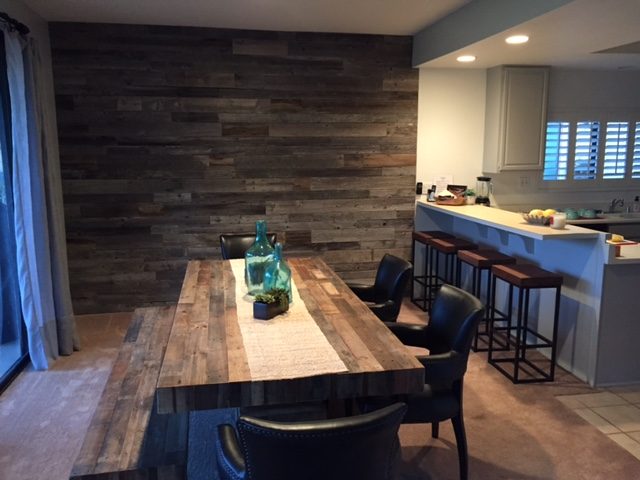
The grey line is silver and driftwood tones with a little brown showing through, and it reads more coastal or modern. It looks best against white walls and a light floor, and it’s the one to pick if the dining chairs are black metal or the table is a pale ash or marble. Grey runs $13.50 per sq ft against $10.25 for brown right now, so a grey wall costs about a third more.
Don’t mix the two on one wall. We’ve seen it done and it never settles.
On width, 3.5 inch planks suit most dining walls because the rows read finer at eating distance. The 5.5 inch brown planks suit a bigger room with a 9 or 10 foot ceiling, where the wider boards keep the wall from looking busy.
Chairs, art and a sideboard against the planks
Chair backs are the one thing a dining room does to a wood wall that no other room does. Keep the table far enough out that the chairs on the wall side stop 4 to 6 inches short of the planks when pushed in, or put a sideboard on that wall so nothing hits it. Where chairs will touch, two coats of matte water-based polyurethane on that strip stops the scuffs from marking the raw face.
Art and mirrors hang the same way they do on drywall, with one change. A 3/8 inch plank won’t hold a screw on its own, so drive it through the plank into a drywall anchor or the framing behind it, using a screw 3/8 inch longer than you’d normally pick. A heavy mirror or a lit sign goes into framing with a longer screw; a light frame can hang off a picture hook tapped straight into a plank.
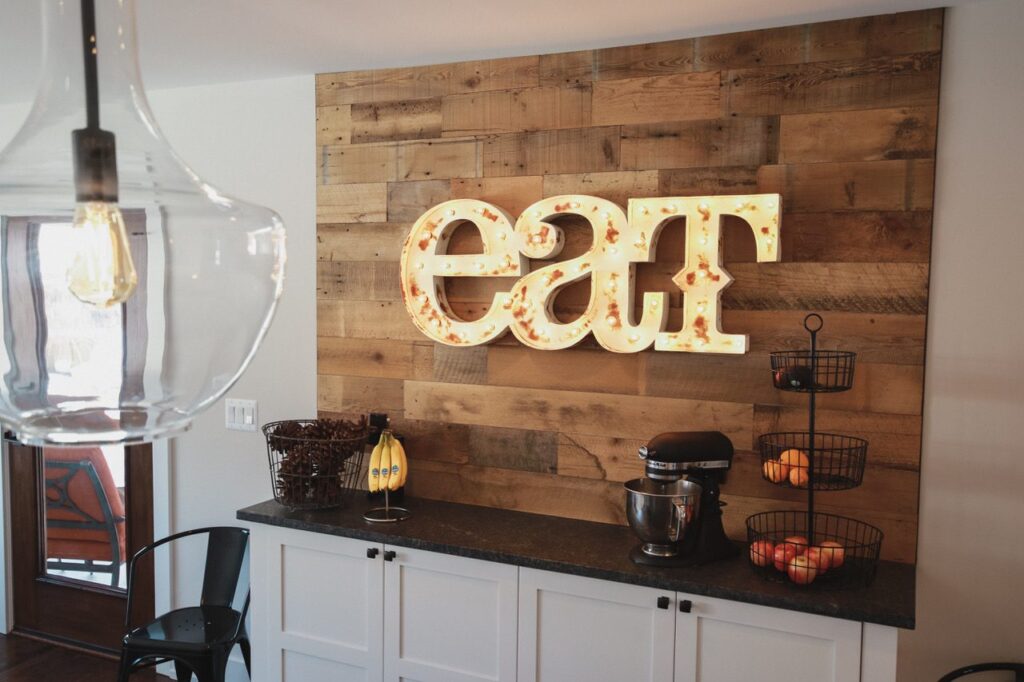
One customer’s eat-in kitchen wall carries a lit marquee sign, a three-tier fruit basket and a stand mixer on the counter below, and the wall is still the first thing you see. That’s the right amount. Reclaimed wood already has texture and color variation, so one or two large pieces look better than a gallery wall of small frames fighting the grain.
A sideboard or buffet against the planks needs a small gap too. Leave a half inch behind it so the wood can move with the seasons and the drawers don’t rub a line into the boards over a few years.
Outlets, thermostats and the switch by the door
A dining room wall usually carries an outlet and the light switch by the door, and in a lot of houses the thermostat as well. Each one takes about ten minutes. Outlets and switches get a box extender ($2 to $5 at any hardware store) that brings the box flush with the new 3/8 inch surface, then the cover plate goes back on top of the planks. Cut the plank opening a quarter inch bigger than the box on each side and the plate hides the cut.
A thermostat mounts on the wall surface, so it moves out onto the planks. Turn the breaker off, unscrew the base, pull the wires through a hole in the plank, and screw the base to the plank with the same screws. Because the planks are only 3/8 inch thick, the wire slack you already have is enough. Don’t bury a thermostat behind the wood or box it in; it needs air moving across it to read the room.
Everything else is the standard install: let the boxes sit in the room 72 hours, snap a level line one row up from the floor, run a bead of construction adhesive on each plank, press it on and shoot a brad or two anywhere to hold it while the glue grabs. You don’t need to find studs. Corners are butt joints with the overlap alternating row by row, and where the wall meets a doorway the planks stop at a plumb line with the ends sanded smooth. The full install guide has the step-by-step.
How many boxes a dining room wall takes
Measure the wall’s width and height in feet, multiply, add 10% for cuts, and round up to the next 20 sq ft box. A 12 by 8 foot wall is 96 sq ft, about 106 with waste, which is six boxes: $1,230 in brown 3.5 inch at the current $10.25 sale price, or $1,620 in grey 3.5 inch planks at $13.50.
Other common dining walls at today’s prices:
- A 10 by 8 foot wall is 80 sq ft, five boxes, $1,025 brown or $1,350 grey.
- A 14 by 9 foot wall is 126 sq ft, seven boxes, $1,435 brown or $1,890 grey.
- A sideboard wall 8 feet wide by 8 high is 64 sq ft, four boxes, $820 brown or $1,080 grey.
- A 16 by 9 foot open-plan wall is 144 sq ft, eight boxes, $1,640 brown or $2,160 grey.
Don’t subtract the window or doorway unless the opening is bigger than a full box; the offcuts around openings get used elsewhere on the wall. Every order over $200 ships free in the US except Alaska and Hawaii, so every one of these walls ships free. Add $20 to $40 for adhesive and brads, and $15 for a quart of matte poly if you’re sealing the chair strip.
Open every box before you start and spread the boards out across the floor by shade. The mistake we see most on finished dining walls is one box’s color landing in a stripe at eye level, right where everyone looks over dinner.
Frequently asked questions
Which wall in a dining room should get reclaimed wood?
The wall the table faces or the wall you see from the doorway, usually the long wall behind the head of the table. Use one wall only, and avoid the window wall because backlight flattens the color of the wood.
Is brown or grey reclaimed wood better for a dining room?
Brown, in most dining rooms, because warm evening light makes grey wood read slightly green. Grey suits rooms that open onto a white or cool-toned kitchen and get strong daylight. Never mix the two colors on one wall.
Will dining chairs damage a reclaimed wood wall?
Only if the chair backs hit the planks every night. Keep the table out so the chairs stop 4 to 6 inches short, or put a sideboard on that wall. Where contact is unavoidable, two coats of matte water-based polyurethane on that strip stops scuffs from marking the raw wood.
How much does a reclaimed wood dining room wall cost?
About $1,230 in brown or $1,620 in grey for a 12 by 8 foot wall, which is six 20 sq ft boxes at $10.25 or $13.50 per sq ft. Add $20 to $40 for adhesive and brads. US shipping is free on every order over $200 except Alaska and Hawaii.
Related reading
- Reclaimed wood kitchen ideas
- Reclaimed wood accent wall: the complete planning guide
- How much wood do I need for an accent wall
- How to clean reclaimed wood walls
- Shop reclaimed wood planks
Order the boxes and clear the wall
Order the boxes of brown 3.5 inch reclaimed wood planks or the grey line, let them sit in the dining room for 72 hours, and move the table out the morning you start.