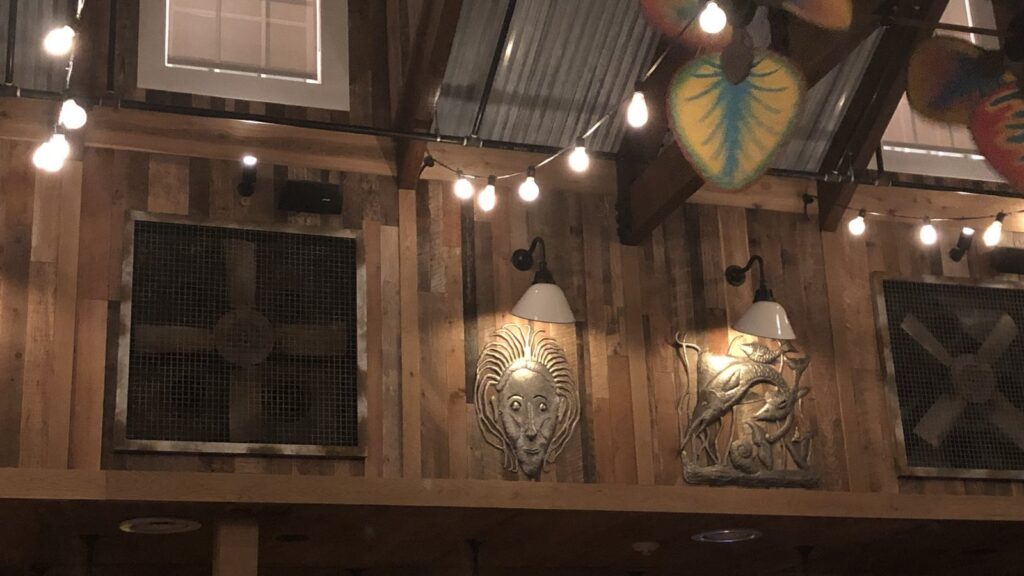
A reclaimed wood restaurant wall works best in the front of the house: behind the bar, on the bar front, on one long dining room wall, or high up where guests look but can’t touch. East Coast Rustic planks are real barn boards, 3/8 inch thick, sold in 20 square foot boxes, so a 12 foot back bar takes 3 boxes (about $615 in brown) and a 20 by 10 foot dining wall takes 11 boxes (about $2,255). The fire marshal and the health inspector both get a say, and you can have it up on a day you’re closed.
Where a reclaimed wood wall pays off in a restaurant
Put the wood where guests look first and longest, which in most restaurants is the wall behind the bar. A back bar section 12 feet wide and 4 feet tall above the counter is 48 square feet, 53 with 10% for cuts, so three boxes of brown 3.5-inch reclaimed wood planks cover it for about $615.
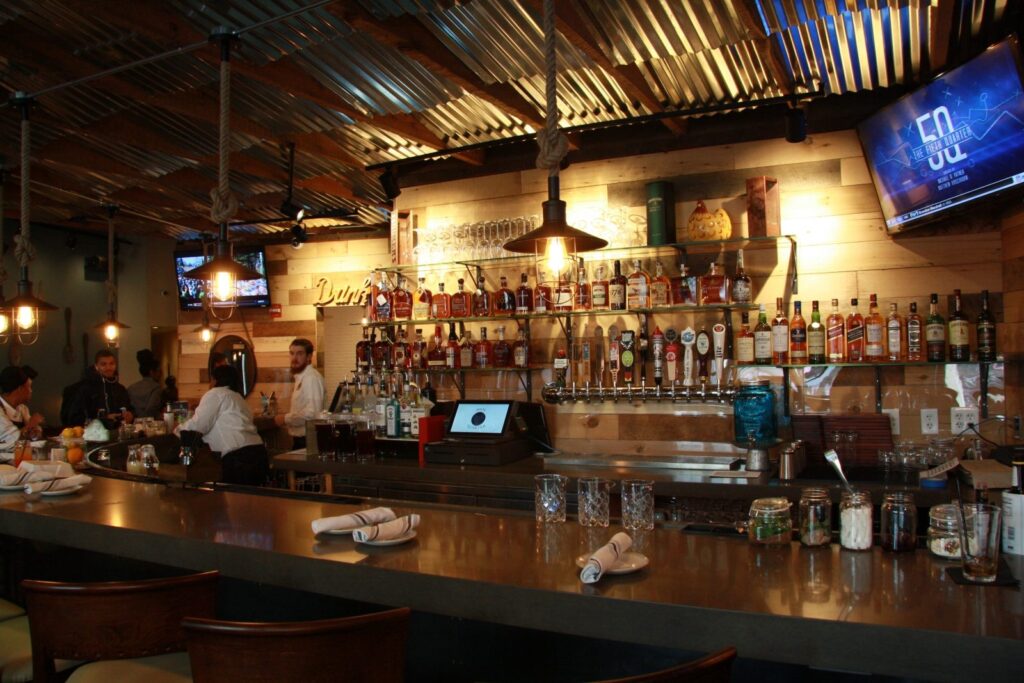
The Hen Quarter bar below is an East Coast Rustic install. The planks run behind the bottle shelves and the taps, lit by warm pendants. Nobody photographs a painted wall behind a bar, but they do photograph this one, and every photo a guest posts is free advertising with your tap handles in it.
After the back bar, the next best spots are the bar front (a 16 foot bar at 3.5 feet tall is 56 square feet, four boxes), the host stand, and one feature wall in the dining room. I’d stop there. Wood on every wall turns a restaurant into a cabin, and one or two planked surfaces against plain paint look more expensive than a room wrapped in boards.
High walls and vertical boards
The upper wall of a tall dining room is the easiest place to use reclaimed wood, because chair backs and mop water never get near it. A band 30 feet long and 6 feet tall above the door line is 180 square feet, 198 with waste, which is 10 boxes, about $2,050 in brown at today’s price.
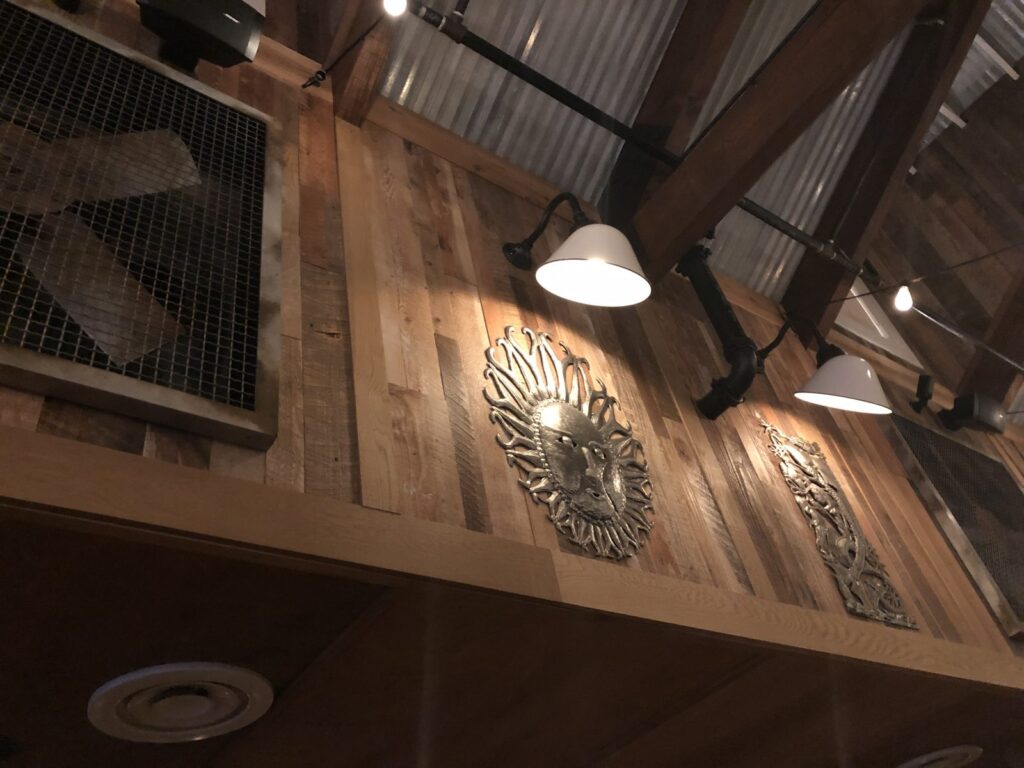
The restaurant below ran the planks vertically above a timber beam, under a corrugated metal ceiling, with gooseneck barn lights and metal art mounted through the boards. Vertical boards make a tall room feel taller, and the short random lengths (nothing in the box is over 48 inches) still stagger the same way they do on a horizontal wall.
Wood that high can stay raw. It only needs a pass with a soft brush on an extension pole a few times a year.
Lighting, signs and your logo on the planks
Light a plank wall from above or from the side, never straight on, and it’ll show every saw mark and color shift in the wood. Gooseneck sconces, cage pendants and a row of string bulbs all do the job for a few hundred dollars, and they screw through the 3/8-inch planks into the wall behind.
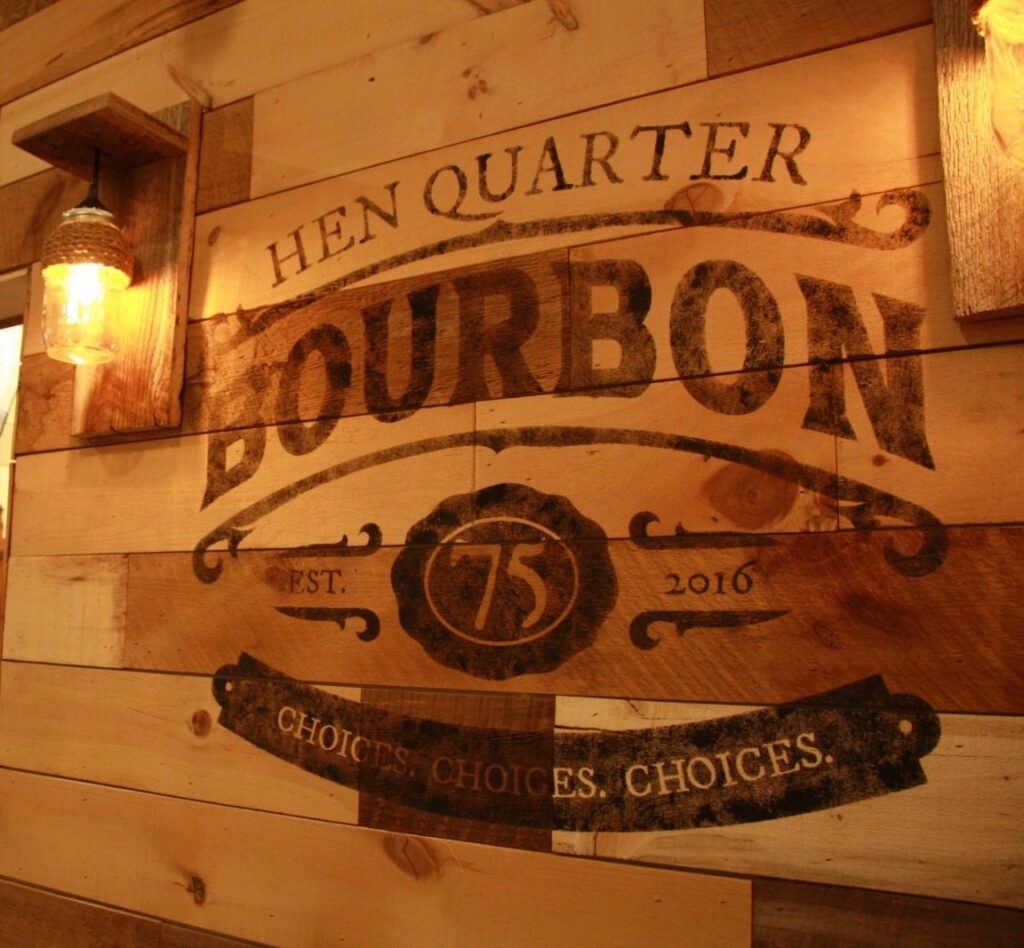
The planks also take paint. Hen Quarter stenciled its bourbon sign straight onto the boards with black paint, and the grain shows through the letters the way it would on an old shipping crate. A sign painter can do the same with your logo in an afternoon, and it costs less than a fabricated sign.
If you want a sign with a lighter background, sort the palest boards out of the boxes before you start and group them where the stencil will go. Each color line ships with lighter and darker boards mixed, so there’s room to plan it.
Fire code, health code and finish
Restaurant walls have two inspectors to satisfy: the fire marshal cares about the flame spread class of the wall finish, and the health department cares about whether a surface near food can be washed. Sort out both before you order.
On the fire side, building codes rate interior wall finishes as Class A, B or C, and the class you need depends on the room, the occupancy and whether the building has sprinklers. Untreated wood generally tests as Class C. A sprinklered dining room often allows that on the walls, while exit corridors and stairways usually need a better class. Ask your architect or the local fire marshal what applies to your space. When a wall needs Class A or B, the common fix is a clear fire-retardant coating brushed on at the job site, and the inspector will want the product data sheet.
The health department works from the FDA Food Code, which calls for smooth, nonabsorbent, easily cleanable surfaces in food prep, dishwashing and storage areas. Rough barn wood isn’t that, so keep it out of the kitchen and off the service line. Dining rooms, bars, waiting areas and hallways are where it belongs.
For finish, seal anything within reach. Two thin coats of matte water-based polyurethane before the boards go up keep drink splashes and fingerprints from soaking in, and the wood still looks dry and unfinished. Along a row of booths, start the planks above the seat backs so chairs and shoulders never rub them. The cleaning guide covers the weekly routine.
Cost, box count and install time
Measure width times height in feet, add 10%, divide by 20 and round up to get the box count. Brown 3.5-inch planks are $10.25 per square foot right now ($11.75 regular), brown 5.5-inch $10.75, grey 3.5-inch planks $13.50 and grey 5.5-inch $14.50, with free US shipping on orders over $200.
A 20 by 10 foot dining wall is 200 square feet, 220 with waste, so 11 boxes: about $2,255 in brown 3.5-inch or $2,970 in grey. For a job that size, send the square footage through the contact page before you order so we can confirm the boxes are on hand.
The install doesn’t need a carpenter. The planks go up with construction adhesive and a brad or two anywhere on the board to hold them while the glue cures, and you don’t need to find studs because the boards are so light. Painted drywall is fine as is. Over tile, brick or block, screw up a layer of plywood first and glue to that. Figure one tube of adhesive for every 40 square feet.
Let the boxes sit inside for 72 hours first, then plan the work for a day you’re closed. A back bar is a one-day job for two people, and a full dining wall usually fits in two. Leave the HVAC running overnight so the adhesive smell is gone before the first table is seated. The install guide walks through each step.
It’s the same wood the Baltimore Ravens put in their studio and Gordon Ramsay used in a home makeover, and it has shipped on more than 1,100 orders.
Frequently asked questions
How much does a reclaimed wood restaurant wall cost?
Brown 3.5-inch planks are $10.25 per square foot on sale and grey 3.5-inch planks are $13.50, sold in 20 square foot boxes. A 12 foot back bar wall takes 3 boxes, about $615 in brown. A 20 by 10 foot dining wall takes 11 boxes, about $2,255 in brown or $2,970 in grey, plus adhesive.
Does a reclaimed wood wall meet fire code in a restaurant?
It depends on the room and the building. Codes rate wall finishes as Class A, B or C, and untreated wood generally falls in Class C. Many sprinklered dining rooms allow Class C on the walls, but exits and corridors often need Class A or B. Check with your architect or fire marshal, and use a clear fire-retardant coating where a better class is required.
Can you put reclaimed wood in a commercial kitchen?
No. Health codes based on the FDA Food Code require smooth, nonabsorbent, easily cleanable surfaces where food is prepared, stored or washed up. Keep reclaimed wood in the dining room, the bar, the waiting area and the hallways.
Should restaurant wood walls be sealed?
Seal anything guests or staff can reach with two thin coats of matte water-based polyurethane before the planks go up. Wood on an upper wall, well above head height, can stay raw and only needs dusting a few times a year.
Related reading
- Reclaimed wood accent wall: the complete guide
- How much wood do I need for an accent wall?
- Is reclaimed wood safe for indoor use?
- Reclaimed wood basement walls and home bars
- Shop reclaimed wood wall planks
Ready to plank the wall behind your bar?
Every plank is a 3/8-inch board cut from a barn that stood for 100 years or more, in brown and grey, 3.5 or 5.5 inches wide, priced per square foot. Start with the brown 3.5-inch reclaimed wood planks and order three boxes for a 12 foot back bar.