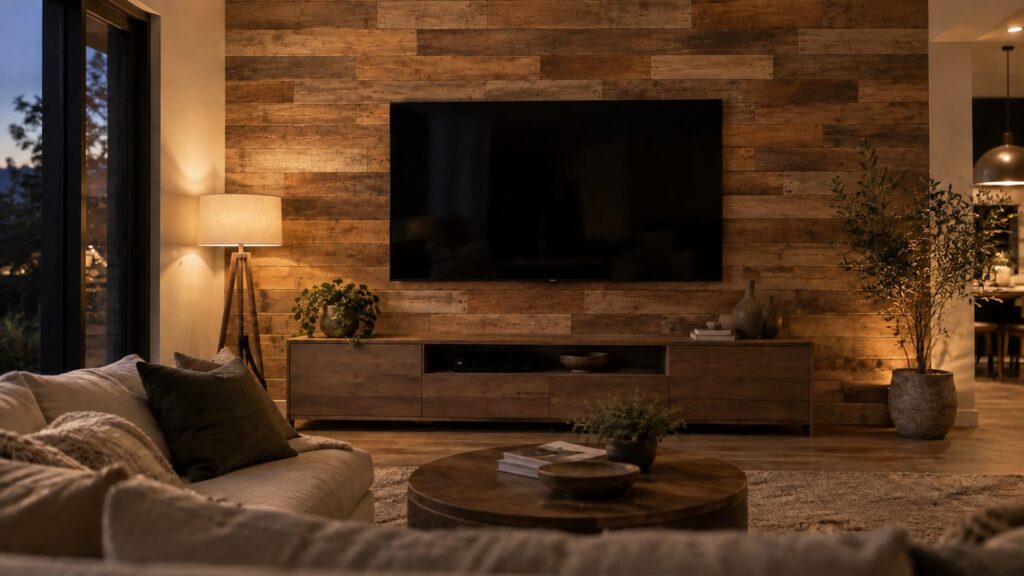
A reclaimed wood TV wall fixes the big black rectangle problem. A mounted TV on bare drywall reads as a screen floating in empty space, while the same TV on a wall of 100+ year old barn wood reads as part of the room. The planks give your eye somewhere to go when the screen is off, and the mixed board tones swallow the black frame instead of fighting it.
Here’s the short version: plank the wall first with adhesive, bolt the TV mount through the planks into the wall framing behind them, and plan your cable routing before the first board goes up. A full 80 square foot media wall lands right around $1,000 in brown planks. The rest of this guide covers the color choice, the mounting details that matter, and the real math.
Why reclaimed wood works behind a TV
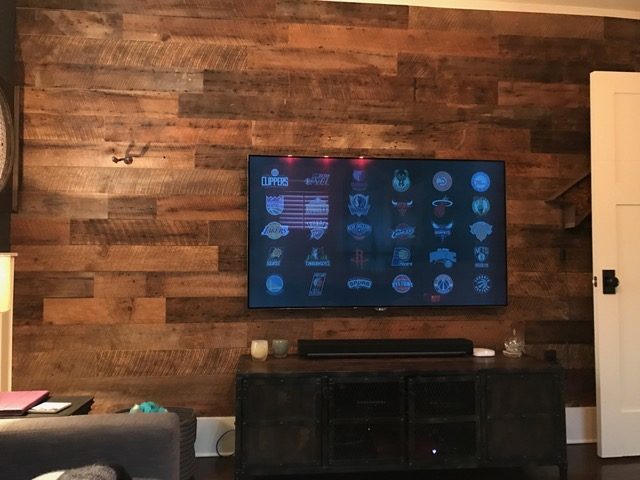
Screens are glossy and new. Barn wood is matte and old. That contrast is the whole trick: against mixed brown or grey boards, the TV becomes one dark panel among many tones instead of the only object on the wall. When the screen’s off, you’ve still got a feature wall instead of a dead black mirror.
It also makes tech-heavy rooms feel warmer. The basement media room below is a real customer install, a full gaming and movie setup against our brown planks, and the wood is what keeps all that hardware from feeling like an electronics store. These are genuine 3/8 inch thick boards cut from 100+ year old barns, in 3.5 or 5.5 inch widths and random lengths up to 48 inches, laid in a brick-pattern stagger. It’s the same wood that’s gone into a Gordon Ramsay home makeover and the Baltimore Ravens facility, and we’ve shipped over 1,100 orders of it to DIYers.
Brown or grey behind the screen?
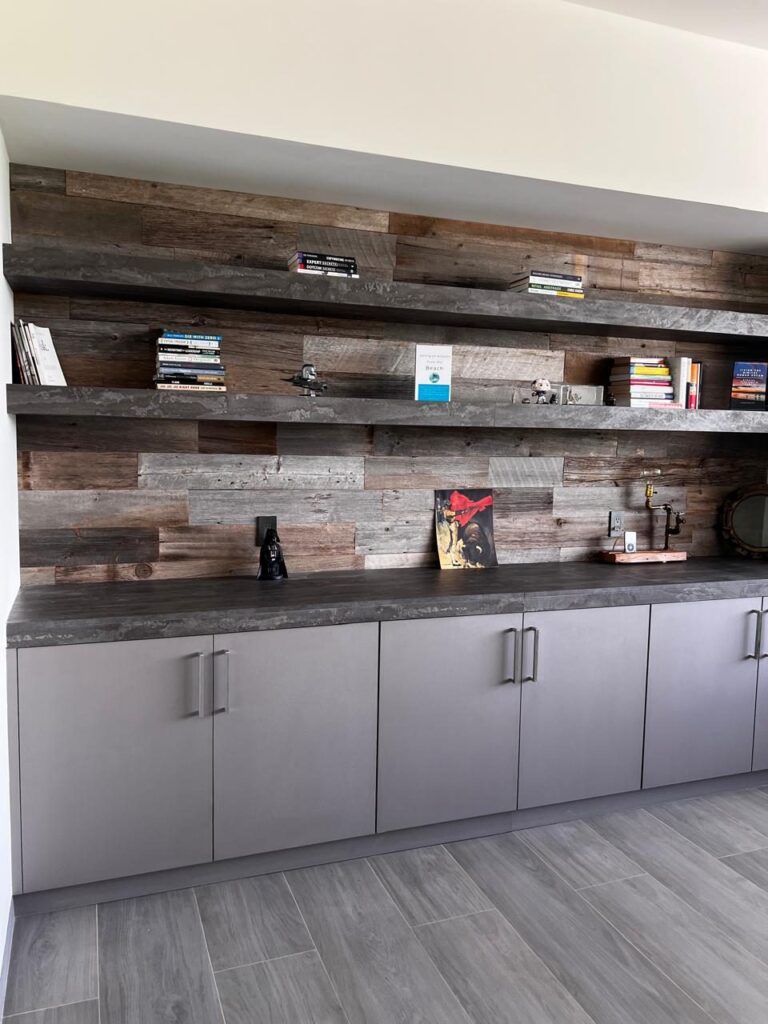
Both lines work behind a TV, so here’s a straight opinion instead of a hedge: brown is the better pick for a basement, den, or dedicated media room, where warm tones and lamp light make the space feel like a retreat. Grey is the better pick for a main family room, because it recedes, stays calm in daylight, and lets the furniture carry the color.
The screen is black either way, so you can’t really get this wrong.
One thing the weathered surface does quietly: it’s matte, so it doesn’t bounce screen light back at you the way paint sheen or glossy paneling can during a dark movie scene. If your room already runs cool, start with the grey reclaimed wood planks and see our grey design guide for palettes. Just don’t mix brown and grey on one wall; we don’t sell a mixed install and it looks busy behind a screen.
Mount the TV to the wall, not the planks
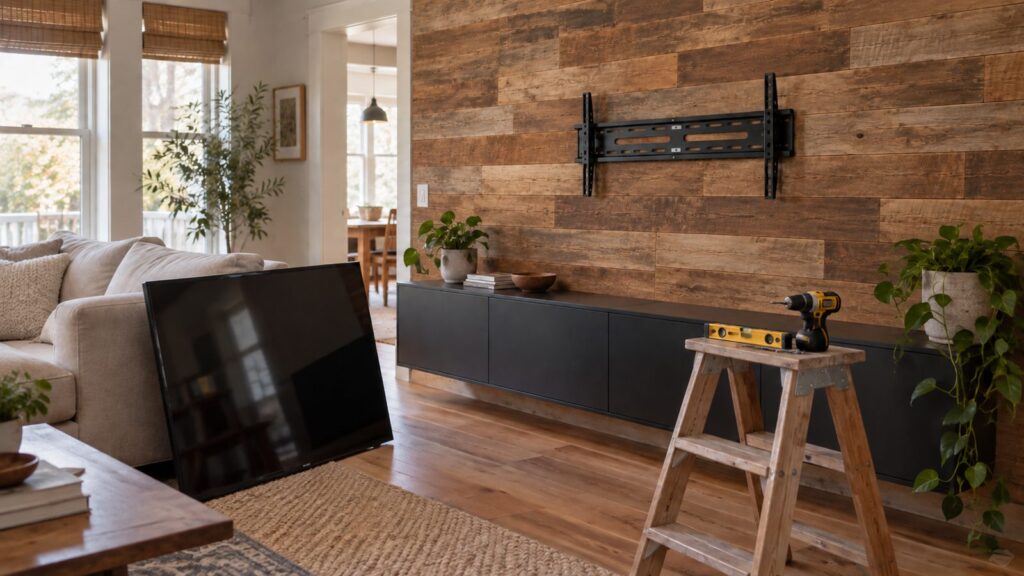
Plank the wall first. The boards go up with construction adhesive and a brad or two anywhere on the plank to hold it while the glue grabs; you don’t need to find studs for the wood itself. With a flat, finished wall you can then put the TV mount exactly where the room wants it instead of planking around a bracket.
Here’s the trap: hanging the TV from the planks. They’re a 3/8 inch finish layer glued to drywall, and they were never meant to carry a heavy TV on a cantilevered arm. Bolt the mount through the planks into the wall framing behind them, using the mount’s own hardware and instructions, and add the plank thickness to your bolt length so you keep full bite. Done that way, the wood carries nothing except its own good looks.
Cables are the other thing to plan before the first board goes up. A recessed in-wall cable kit puts one plate behind the TV and one down by the console, and you cut the planks around those plates the same way you’d cut around an electrical outlet. A soundbar follows the TV rule: bolt it through to the framing, never to the boards.
What a reclaimed wood TV wall costs
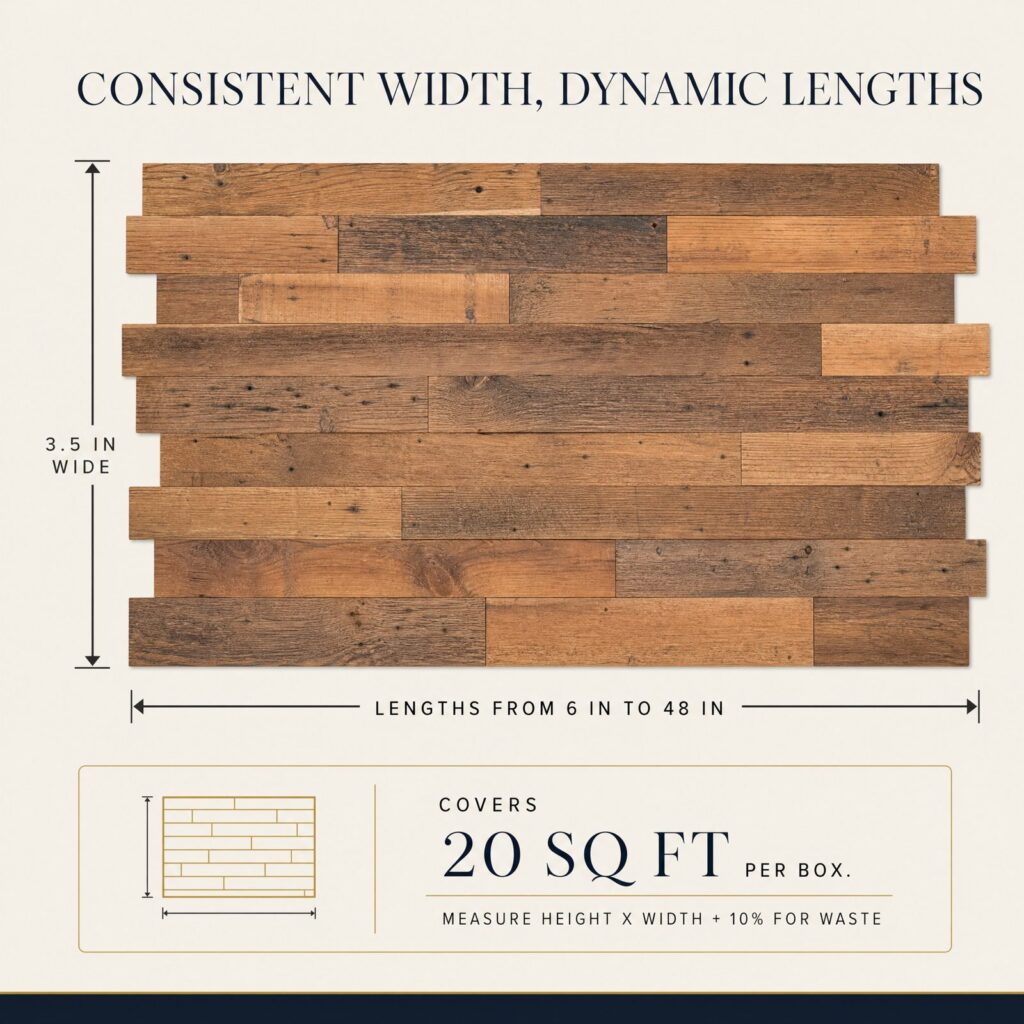
The wood is priced per square foot and ships in 20 square foot boxes. Brown currently runs $10.25 per square foot in the 3.5 inch width and $10.75 in the 5.5 inch, so a box lands a little over $200. Grey runs $13.50 to $14.50 per square foot. US shipping is free over $200, which means basically every TV wall order ships free.
The math for a typical media wall: 10 feet wide by 8 feet tall is 80 square feet, plus about 10 percent for cuts brings you to 88, so you’d order five boxes of the 3.5 inch brown reclaimed wood planks, about $1,025 at today’s pricing. That’s a wall-to-wall media wall for the price of a mid-range TV. On a tighter budget, a generous panel behind the TV, say 8 feet by 5 feet, needs just two boxes and still frames the screen properly. Our coverage guide has the box math for any wall size.
Frequently asked questions
Can I mount a TV directly to the reclaimed wood planks?
No. The planks are a glued-on finish layer, not structure. Bolt the TV mount through the planks into the wall framing behind them with the mount’s hardware, adding about 3/8 inch to your bolt length for the wood. The planks themselves don’t need studs; the TV mount absolutely needs solid framing.
How do I hide the TV cables on a wood plank wall?
Install a recessed in-wall cable kit before you plank, with one plate behind the TV and one near the floor by your console. Then cut the boards around the plates just like an outlet. If the wall’s already planked, you can still add a kit; you’ll just make the cutouts in place with an oscillating tool.
Will heat from the TV damage the wood?
No. Modern flat screens run far cooler than the old plasma sets, and this wood spent a century in a barn through worse summers than your living room will ever have. Leave the TV’s vents unblocked and you’re fine, with no special clearance needed.
Should the wood cover the whole wall or just the area behind the TV?
Full wall, if the budget allows, because it reads as architecture instead of a backdrop. If you’d rather do a panel, size it generously: at least a couple of feet past the TV on each side and floor to ceiling if you can, so the screen sits inside the feature rather than covering most of it.
Related reading
- How much a reclaimed wood accent wall costs
- How to install a reclaimed wood accent wall
- How to cut planks around an outlet
- Shop DIY reclaimed wood walls
Ready to see the wood in person?
A TV wall is the most-looked-at wall in the house, so the wood has to be the real thing. Start with the 3.5 inch brown reclaimed wood planks or the grey line if your room runs cooler. Every box covers 20 square feet, and US orders over $200 ship free.