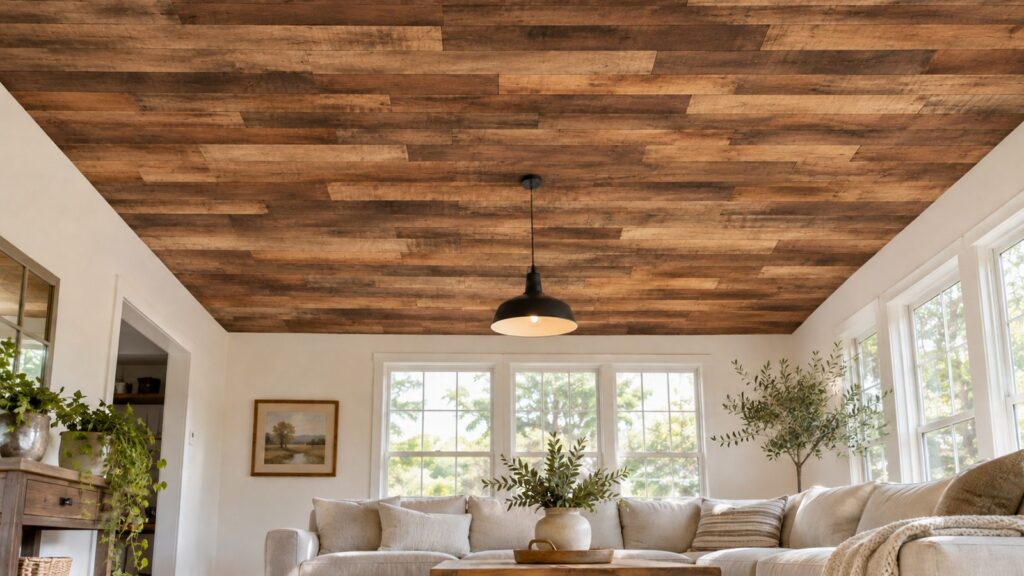
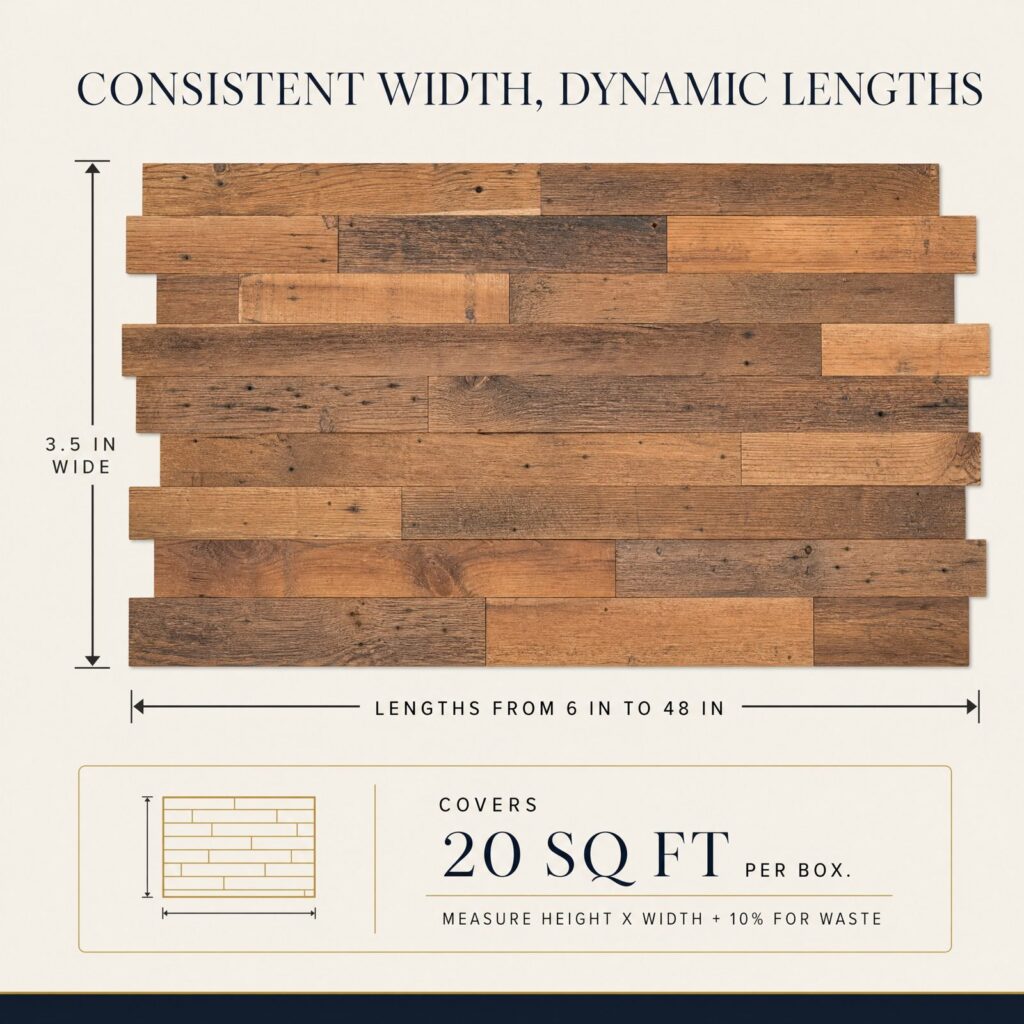
The best reclaimed wood ceiling ideas use the same thin planks you’d put on an accent wall, just overhead: a tray ceiling inset in an entryway, a powder room or hallway ceiling, a full living room or bedroom ceiling, or a sloped attic. East Coast Rustic’s planks are 3/8 inch thick and 3.5 or 5.5 inches wide, in random lengths up to 48 inches, so they go up over drywall with construction adhesive and a brad or two, and a 20 square foot box runs about $205 in brown. Here are the seven ceilings we see customers build most, with the coverage math for each.
A tray ceiling inset
A tray ceiling is the easiest reclaimed wood ceiling to pull off, because the recessed panel already has a finished edge and you only plank the flat inside. A typical 4 by 8 foot entry tray is 32 square feet, which is two boxes of planks.
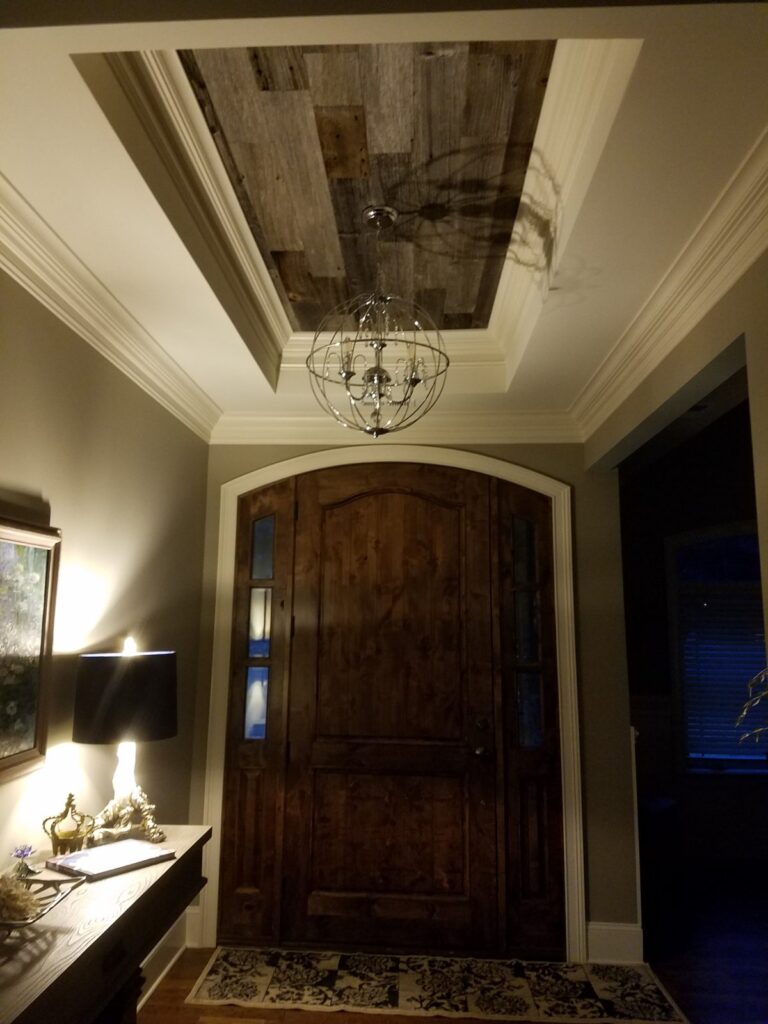
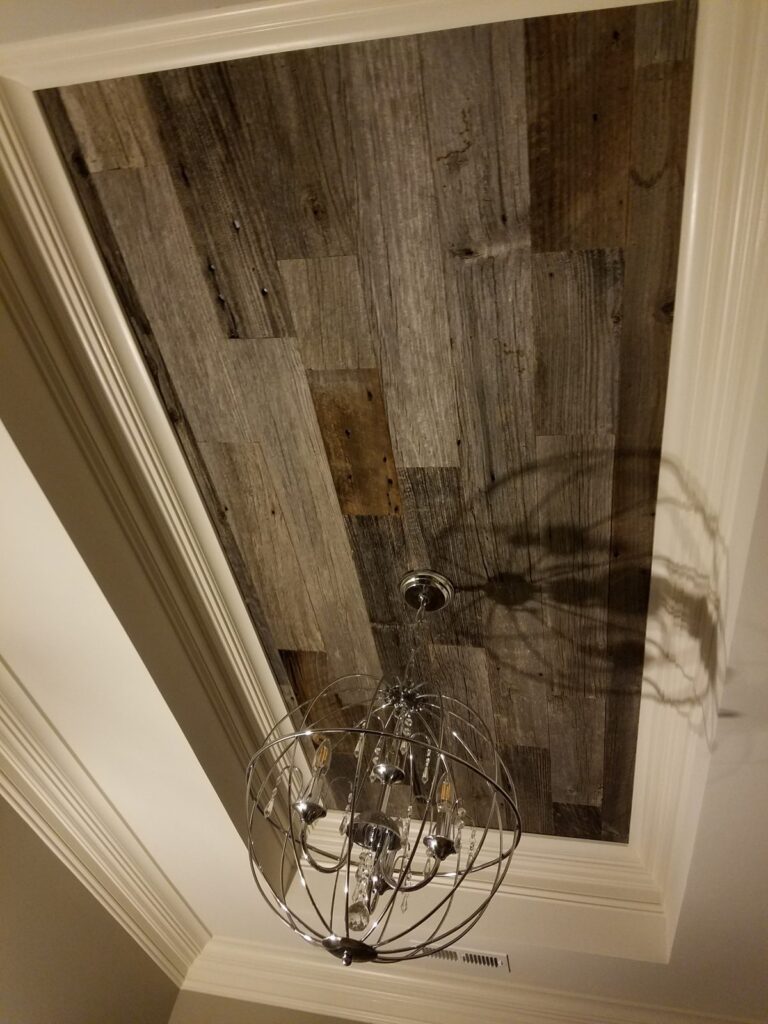
The photo below is a customer’s front entry, with grey planks set into the tray and a chrome orb chandelier hung from the middle. The painted step around the inset gives the wood a clean stop line, so there’s no edge work at all: the planks run to the inside of the tray, the end boards get a quick sanding, and the shadow line does the rest. Grey reads softer and more formal against white paint. The same inset in brown goes warmer and suits a dining room or a primary bedroom.
Plank direction matters more here than anywhere else, so run the boards the long way of the tray and the stagger reads from the doorway.
Powder rooms, hallways and closets
Small ceilings are where reclaimed wood gives the biggest effect for the least money: a 5 by 8 foot powder room ceiling is 40 square feet, 44 with the usual 10% for cuts, so three boxes cover it. You’ll be done in an afternoon.
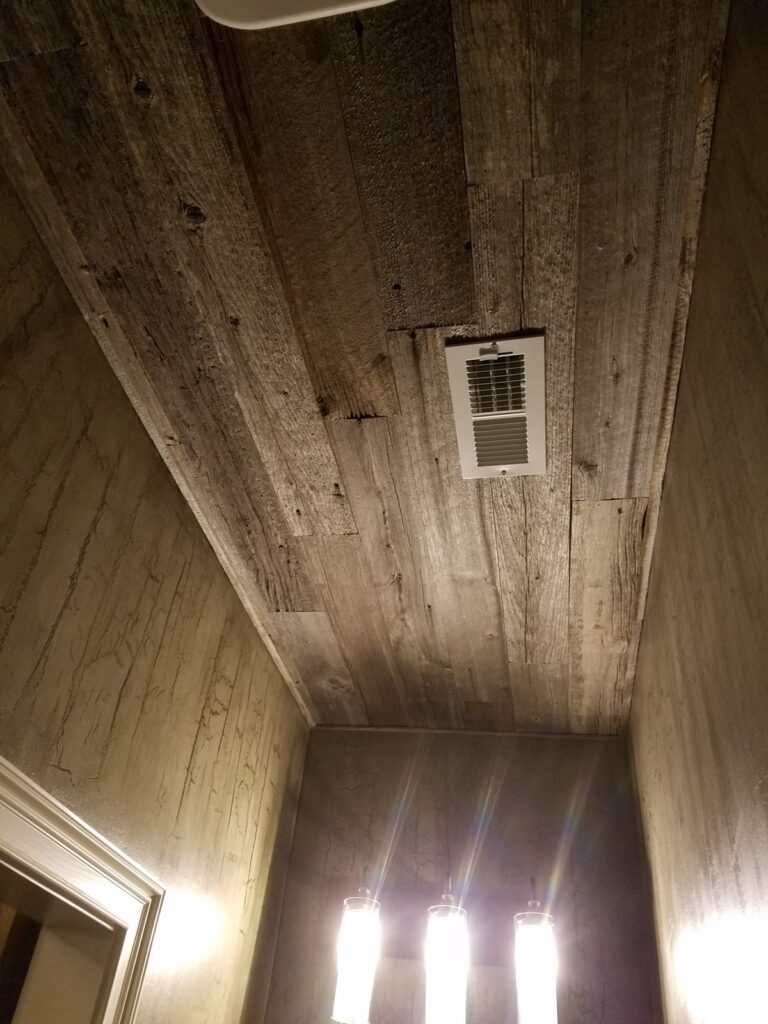
The customer powder room below is a good example. Grey planks run the length of the room, the heat register was cut around and screwed back on over the wood, and the textured wallpaper on the walls carries the same silver tones. Here’s the thing about a tiny room: you see every inch of the ceiling, so sort the boards first. Lay them out on the floor, mix the light and dark ones evenly, and keep the two best boards for the spot right above the mirror.
Hallways and walk-in closets work the same way. A long hallway gets planks run lengthwise so the space reads longer, and a closet is the perfect first project if you want a practice run before you tackle a living room.
Full-room and sloped ceilings
A full living room or bedroom ceiling takes the most planks but changes the room more than any wall can: a 12 by 15 foot room is 180 square feet, 198 with waste, which is 10 boxes, about $2,050 in brown 3.5-inch planks at the current $10.25 per square foot, or about $2,700 in grey.
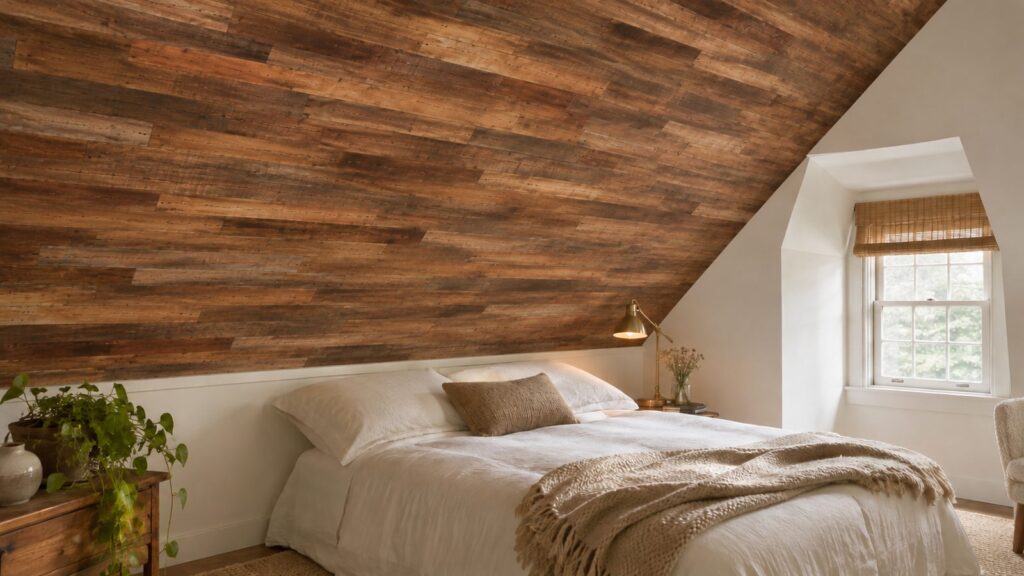
Sloped attic ceilings and cathedral ceilings are the same job with a taller ladder. Run the planks across the slope, not up it, so the rows read level from the floor, and start at the eave wall where any short final row will sit lowest and out of sight. On a vaulted ceiling with exposed beams, plank the bays between the beams and leave the beams bare. The boards stop at the beam on a straight line and the beam itself becomes the border.
My opinion: in a full room, pick the 5.5-inch width. The wider boards cover faster, and across 180 square feet the larger scale looks more like a real barn loft than the 3.5-inch board does. Both widths come in brown and grey, so the color choice is separate.
Grey or brown overhead, and how to light it
Brown planks make a ceiling feel cozier, grey planks keep it light and airy, and the fixture you hang from it decides which way the room goes. A ceiling is the one surface in a room that never gets a picture frame or a bookshelf in front of it, so the wood color shows at full strength.
Grey works in a bathroom, an entry or any room with white walls and chrome or black fixtures, and it reads coastal and clean. Brown suits bedrooms, dens, basements and dining rooms, and it pairs well with black iron and leather. The planks arrive hand-sorted with light and dark boards mixed inside each color line, and that variation is all the contrast you want overhead.
Keep one color per ceiling.
Lighting is the part people skip. A warm pendant or a chandelier with exposed bulbs throws shadows across the saw texture and makes the boards look deeper at night, as in the customer entry below. Flat dome lights flatten the wood out. If you’re adding recessed lights, cut the holes in the planks with a hole saw after the boards are up, and the light’s own ring covers the cut edge.
Cost, coverage and how the planks go up
Measure the ceiling in feet, multiply length by width, add 10% for cuts, then divide by 20 to get your box count: a 10 by 12 foot bedroom is 120 square feet, 132 with waste, so 7 boxes. At $10.25 per square foot that’s about $1,435 in brown 3.5-inch planks, or about $1,890 in grey 3.5-inch planks at $13.50, with free US shipping on orders over $200.
The install is the same adhesive method as a wall, with one difference: gravity. Construction adhesive does the permanent holding, a dab of hot glue gives instant grab so the board stays put the second you press it, and a brad or two anywhere on the plank pins it while the adhesive cures. You don’t need to find joists. At 3/8 inch thick these boards weigh very little, so the glue bond into drywall carries them, which is why the same four products that build our accent walls go on ceilings without any change.
Here’s the trap: popcorn texture. The planks will hide it, but adhesive wants a solid surface, so knock the loose texture down with a wide putty knife where the boards land before you glue. It takes an hour and the bond is far better. Let the wood sit in the room for 72 hours before you start, snap a chalk line for the first row, stagger every seam like brickwork, and work around light boxes the same way you’d cut around an outlet on a wall: kill the breaker, drop the canopy, plank past the box, re-hang the fixture over the cut. The stagger guide and the coverage guide cover the rest. It’s the same wood that went into Gordon Ramsay’s home makeover and the Baltimore Ravens studio, shipped on more than 1,100 orders.
Frequently asked questions
Can you put reclaimed wood planks on a ceiling?
Yes. East Coast Rustic’s planks are 3/8 inch thick, so they go on a drywall ceiling with construction adhesive, a dab of hot glue for instant grab and a brad or two to pin each board while the glue cures. It’s the same product and the same method as an accent wall.
How much does a reclaimed wood ceiling cost?
Brown 3.5-inch planks are $10.25 per square foot right now and grey 3.5-inch planks are $13.50, in 20 square foot boxes. A 120 square foot bedroom ceiling needs 7 boxes, about $1,435 in brown or $1,890 in grey, and US shipping is free over $200.
Do wood plank ceilings make a room feel smaller?
Brown planks make a standard 8 foot ceiling feel cozier but not lower, and grey planks keep it feeling light. On a vaulted or sloped ceiling the planks draw the eye up and make the height more obvious, not less.
Which direction should ceiling planks run?
Run them the long way of the room, or the long way of a tray inset, so the brick-pattern stagger reads from the doorway. On a sloped ceiling, run them across the slope so the rows look level from the floor.
Related reading
- Reclaimed wood ceiling planks (shop by the square foot)
- Reclaimed wood accent wall: the complete guide
- How to stagger wood planks on a wall
- How to cut around an electrical outlet
- Shop all DIY reclaimed wood walls
Ready to look up at real barn wood?
Every plank is a 3/8-inch board milled from a 100-year-old barn, in warm brown and weathered grey, 3.5 or 5.5 inches wide, priced per square foot with free US shipping over $200. Start with the brown 3.5-inch reclaimed wood planks and order 10% more than your ceiling measures.