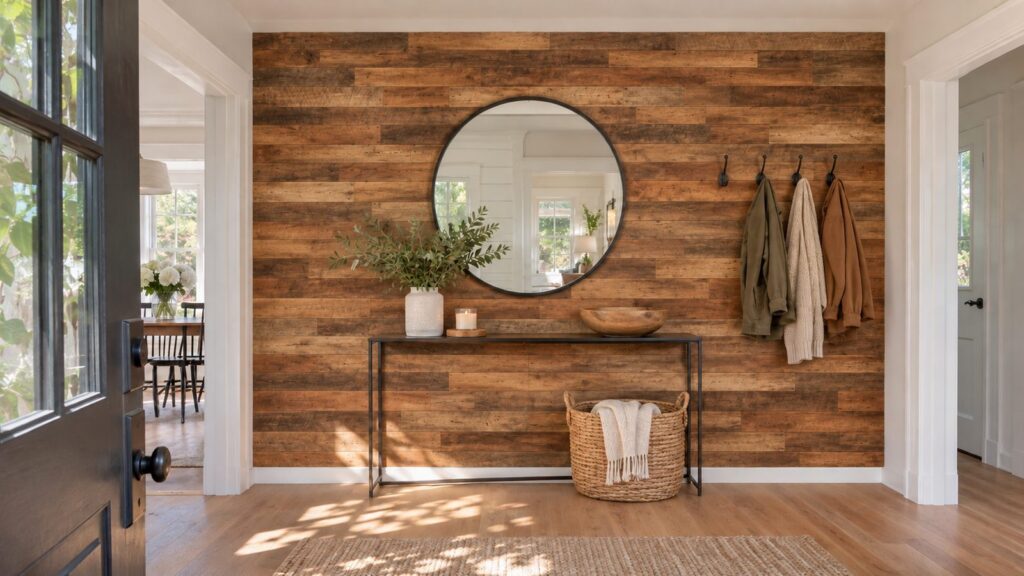
A reclaimed wood entryway wall is the highest-impact spot in a house for barn wood, because every guest sees it in the first three seconds and the wall is usually small. A typical 6 by 8 foot foyer wall is 48 square feet, which is three 20 square foot boxes of East Coast Rustic’s 3/8-inch-thick planks, about $615 in brown or $810 in grey at today’s prices, and it goes up in an afternoon with construction adhesive. Here are the entry projects customers build most, with real photos, the box count for each, and the one thing that trips people up: hooks.
The wall facing the front door
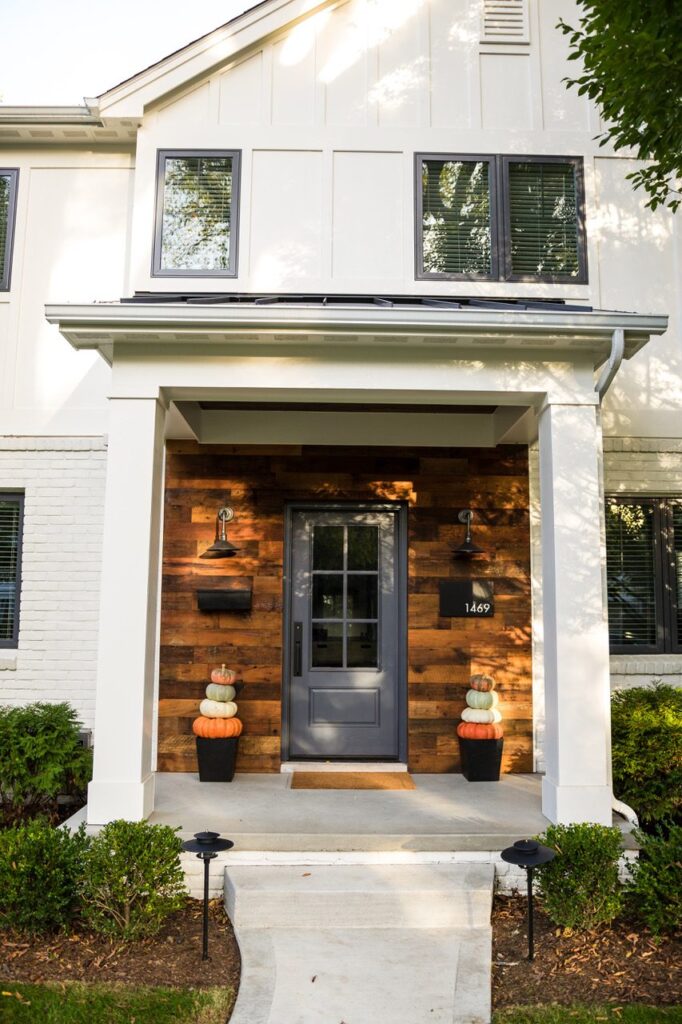
The wall you see when the door opens is the one to plank, and a 6 by 8 foot section takes 3 boxes of brown 3.5-inch reclaimed wood planks, about $615 at $10.25 per square foot. One customer took the idea a step further: the front entry below has brown planks wrapping the recessed porch wall around the door, under a deep roof, with the sconces and house numbers mounted straight through the boards.
Inside, keep the rest of the foyer quiet. White walls, a slim black or oak console, one round mirror, a basket for shoes. The planks arrive hand-sorted with lighter and darker boards mixed inside each color line, and that variation is all the pattern a small space needs. Brown reads warm and traditional next to wood floors; grey suits a coastal or modern house with white oak and black hardware.
A word on the porch version. We sell these planks for interior walls, so if you copy it, give the boards two coats of an exterior-rated clear finish before they go up and keep them under a roof, out of rain and direct sun. A dry, covered entry like this one is as far outside as the wood should go.
Mudroom bench nooks and drop zones
A mudroom nook is the cheapest reclaimed wood project in the house: the back wall of a 3 foot wide bench cubby is about 21 square feet, so two boxes cover it with planks to spare, about $410 in brown. The customer mudroom below is exactly that, a planked niche between white built-in lockers with a bench cushion, two pipe hooks and nothing else.
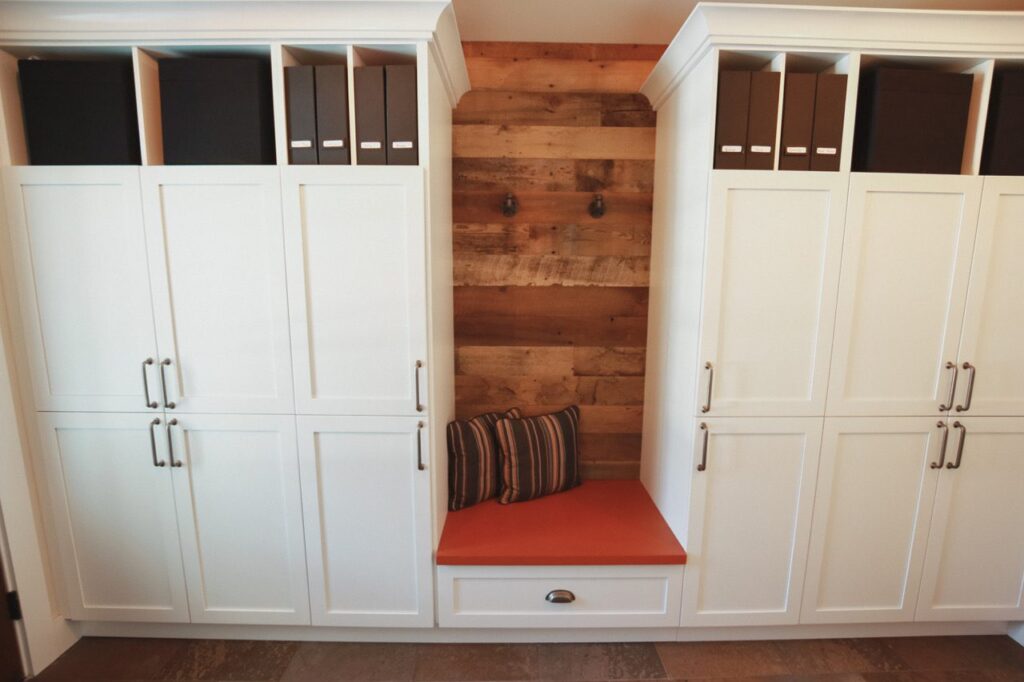
What makes it work is contrast. The wood sits inside crisp white cabinetry, so the boards read like a framed picture instead of a rustic room. Plank only the back of the niche, run the boards horizontal so the stagger reads across the width, and stop the last row at the bench top. The plank ends butt the cabinet sides, so there’s no edge work at all.
Here’s the trap: wet boots and dripping coats. The wall behind a mudroom bench takes a beating, and the planks will take the same splashes, so brush on two thin coats of matte water-based polyurethane before the boards go up. It takes an hour on a drop cloth, and the wood wipes clean for years. The prep and sealing guide covers what to use.
Hallways and stair walls
A hallway is the one entry wall worth measuring twice: a 12 foot run at 8 feet tall is 96 square feet, 106 with 10% for cuts, which is six boxes, about $1,230 in brown or $1,620 in grey 3.5-inch planks.
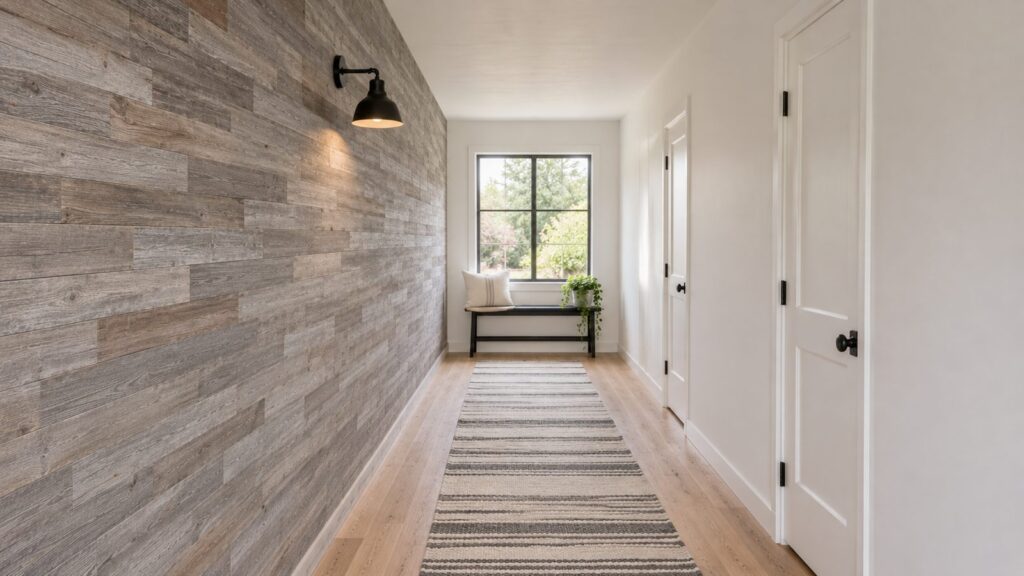
Plank one side only.
Two planked walls in a 3 foot wide hall feel like a barn stall; one wall feels like a gallery. Grey is my pick for a hallway. Halls get little daylight, and the silver and taupe boards keep a narrow space from going dark, especially next to white doors and a striped runner. Run the planks horizontal to stretch the hall longer, and start the first row at the far end so any short final row lands by the doorway you’re walking away from.
A stair wall is the same job on a slope. Plank it to the ceiling like any other wall, or stop at a line snapped parallel to the handrail and give the end boards a quick sanding. Hands run along a stair wall every day, so it gets the same two coats of matte poly as the mudroom.
Hooks, mirrors and hardware on a plank wall
Coat hooks, a mirror and a sconce all mount straight through the planks, as long as the screw reaches the wall behind: the 3/8-inch board is the finish, not the anchor. The customer porch below has two sconces, a mailbox and a house number plaque screwed through the wood, and the same rule holds inside for a hook rail loaded with winter coats.
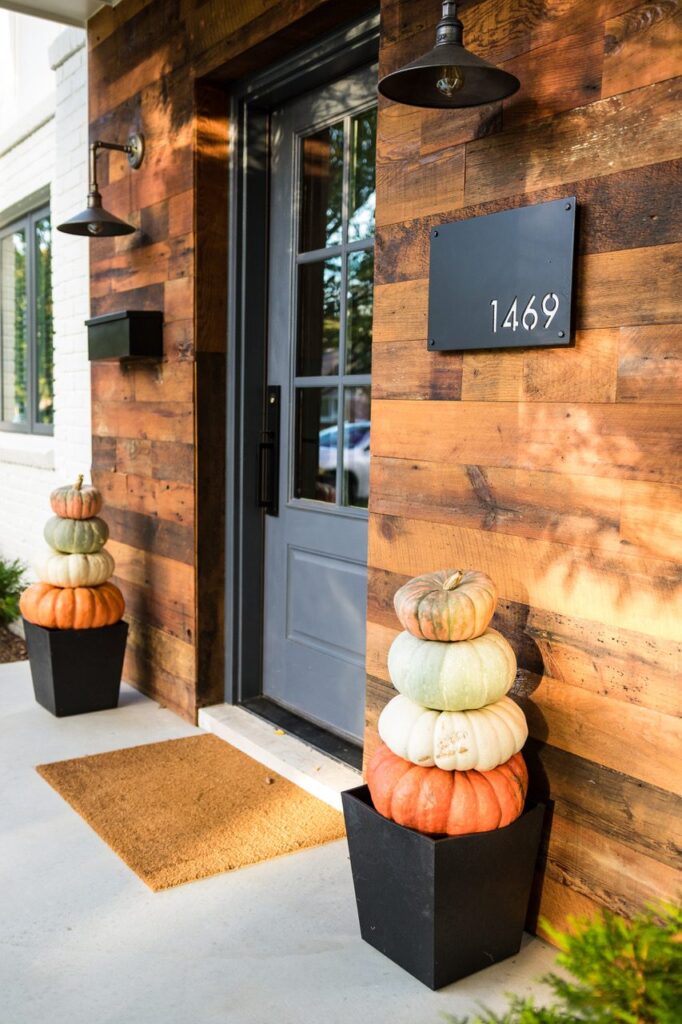
Use a screw long enough to pass through the plank and well into the wall behind it, with a toggle or a self-drilling drywall anchor rated for the load, or into framing if a piece happens to sit where you want the hook. A rail of five hooks under heavy coats can carry 50 pounds on a busy morning, so anchor it like you mean it. Pre-drill the plank so the old wood doesn’t split near an edge.
Mirrors and art hang the same way. A picture hook driven through a plank into drywall holds a light frame; anything over about 10 pounds gets a screw and an anchor. Switches and outlets get the same treatment as any accent wall: kill the breaker, plank past the box, and reset the device on longer screws so the cover plate sits flat on the wood. The outlet guide walks through it.
Cost, coverage and the install
Measure width times height in feet, add 10% for cuts, divide by 20 and round up to get the box count: a 6 by 8 foot entry wall is 48 square feet, 53 with waste, so 3 boxes. Brown 3.5-inch planks are $10.25 per square foot right now ($11.75 regular), brown 5.5-inch $10.75, grey 3.5-inch $13.50 and grey 5.5-inch $14.50, in 20 square foot boxes with free US shipping on orders over $200.
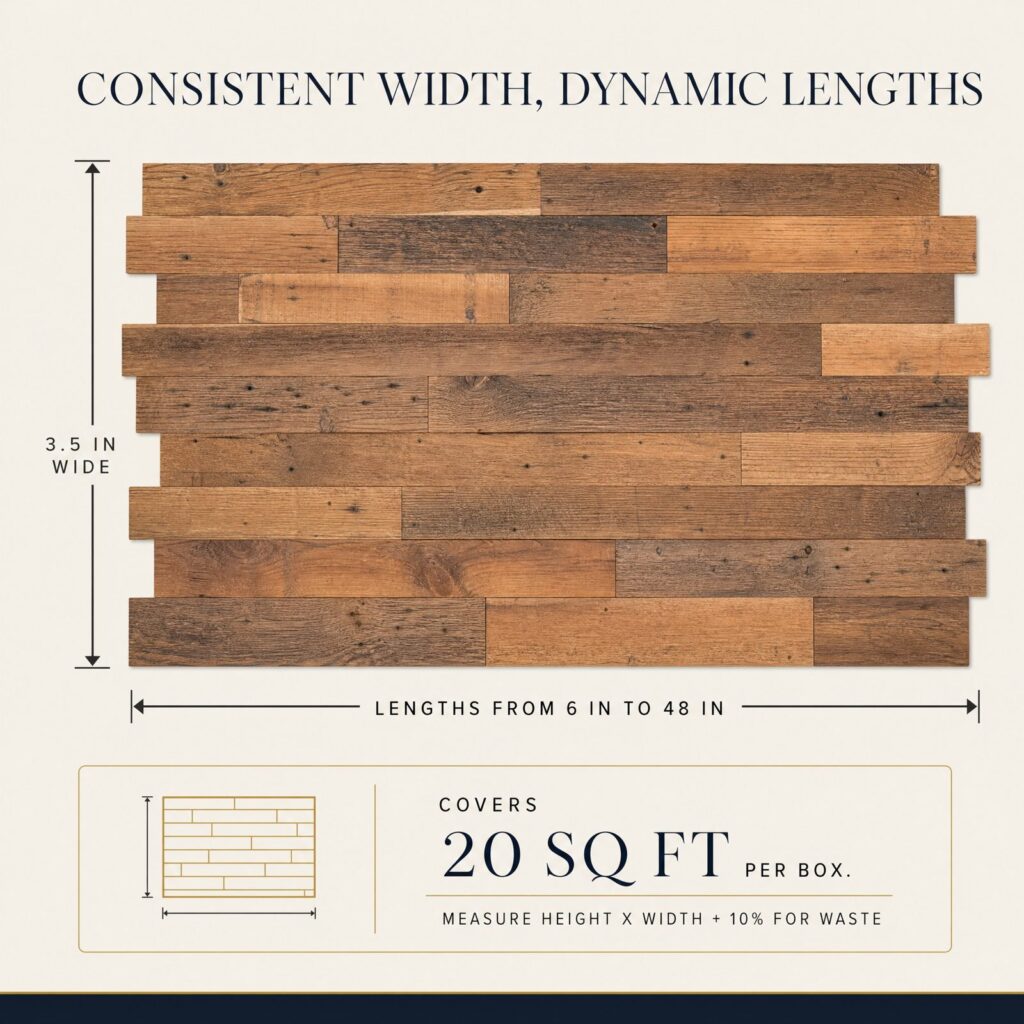
The install is the same for every project in this post. Let the boxes sit in the house for 72 hours, snap a level line for the first row, and put each plank up with construction adhesive and a brad or two anywhere on the board to hold it while the glue cures. You don’t need to find studs; at 3/8 inch thick the boards weigh very little and the adhesive bond into drywall carries them. Stagger every seam like brickwork, and at an inside corner just butt the boards and alternate which wall overlaps, row by row. The stagger guide shows the layout.
Budget a 6 by 8 foot foyer wall at about $615 in brown or $810 in grey, plus $20 to $40 of adhesive and brads, and plan on one afternoon. It’s the same wood that went into Gordon Ramsay’s home makeover and the Baltimore Ravens studio, shipped on more than 1,100 orders, and every board already spent 100-plus years on a barn before it reached your front door.
Frequently asked questions
How much does a reclaimed wood entryway wall cost?
A typical 6 by 8 foot foyer wall is 48 square feet, 53 with 10% for cuts, so three 20 square foot boxes. At $10.25 per square foot that’s about $615 in brown 3.5-inch planks, or about $810 in grey at $13.50, with free US shipping over $200. A mudroom bench niche is about two boxes.
Can you hang coat hooks on a reclaimed wood wall?
Yes. Screw the hook or rail through the 3/8-inch plank and into the wall behind it with a toggle or drywall anchor rated for the weight, or into framing if one sits where you want the hook. The plank is the finish, not the anchor, and a loaded coat rail can carry 50 pounds.
Should an entryway wood wall be sealed?
A mudroom bench wall and a stair wall should get two thin coats of matte water-based polyurethane before the boards go up, because boots, coats and hands hit them daily. A foyer wall behind a console table can stay raw. Anything on a covered porch needs an exterior-rated clear finish and protection from rain and sun.
Brown or grey reclaimed wood for an entryway?
Brown planks read warm and traditional and suit wood floors and black iron hardware. Grey planks keep a dim hallway or a small foyer feeling light and suit white oak, white doors and coastal or modern houses. Both come 3.5 or 5.5 inches wide; keep one color per wall.
Related reading
- Reclaimed wood accent wall: the complete guide
- Reclaimed wood wall decor: half walls, niches and framed panels
- How much wood do I need for an accent wall?
- How to stagger wood planks on a wall
- Shop all DIY reclaimed wood walls
Ready to plank the first wall guests see?
Every plank is a 3/8-inch board milled from a 100-year-old barn, in warm brown and weathered grey, 3.5 or 5.5 inches wide, priced per square foot with free US shipping over $200. Start with the brown 3.5-inch reclaimed wood planks and order three boxes for a standard foyer wall.